
Coolant Conductivity: The Invisible Red Line in Liquid-Cooled Data Centres
Coolant is never just water, and water is never just an insulator. Why conductivity is the safety line nobody sees until a joint weeps, and why the real test is stability, not a one-time low number.
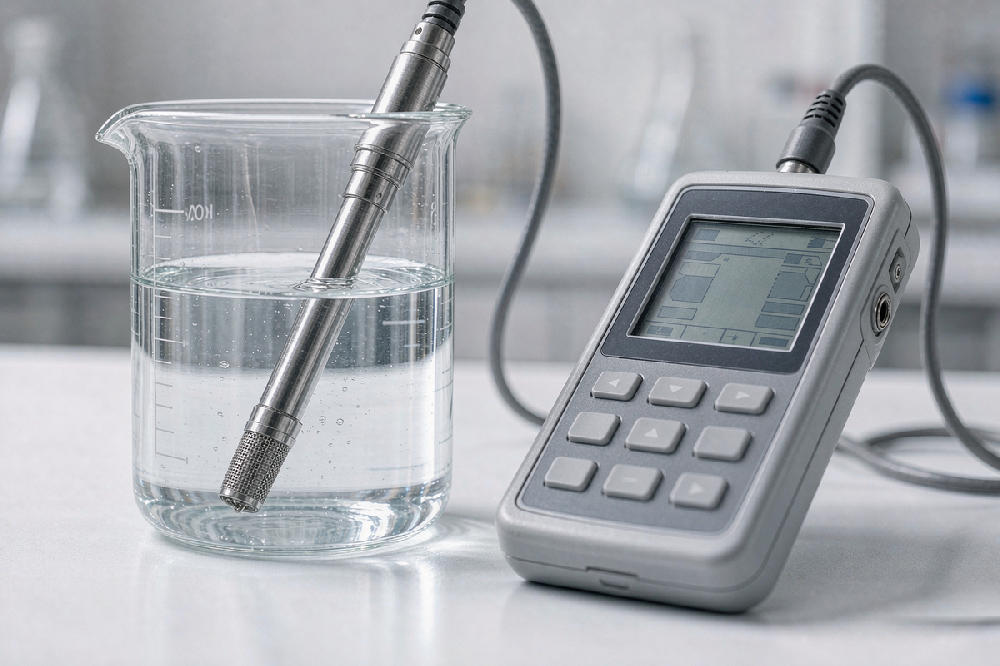
Asingle AI training cabinet now pulls past 100 kW, and the air handlers have left the room. What flows against the cold plates is no longer a lab curiosity. It is a safety surface, and the number that says whether it is still safe is conductivity — the specification almost nobody thought about until it was the only thing standing between them and a short circuit.
Almost everything said about that number is slightly wrong, and each wrong version leads a buyer somewhere expensive. At Glacier Coolant we spend a fair part of every technical call correcting them, so here they are in one place.
Take the five sentences you will hear most often, one at a time.
Five sentences you will hear
| Sentence | Verdict |
|---|---|
| "The coolant is an insulator." | Wrong, and by design |
| "It tested fine at commissioning." | True, and nearly meaningless |
| "It only matters once something leaks." | Backwards |
| "A bit of water in the top-up is harmless." | The most expensive habit in the hall |
| "Lower is always better." | Sometimes, and sometimes a distraction |
"The coolant is an insulator."
It is not, and it is not trying to be.
A coolant is a formulated solution. The inhibitors, the pH adjusters and the biocides that make it protect your loop all carry ions. The water it is built on already carries chloride, sulphate and hardness. Ion concentration is what makes a solution conductive, and conductivity is simply how well it carries.
So the fluid protecting your loop is, deliberately, a mild conductor. That is normal and it is not the danger. The danger is that it conducts more next year than it did on the day it was filled, and that at the wrong moment it touches something live.
At Glacier Coolant we start every conductivity conversation here, because once you accept that the fluid conducts, the rest of the subject stops being mysterious.
"It tested fine at commissioning."
It did, and that reading proves almost nothing.
A low number at fill is largely a property of what came out of the drum. The loop then spends every day changing it. Metal ions dissolve from the pipework and the plates. Top-up water imports whatever it was carrying. Microbes acidify the solution. The inhibitor package that holds the chemistry steady is slowly consumed doing its job.
None of that is a sudden event. Coolant very rarely fails in a day. It drifts for months, quietly, while the fill-day number sits in a commissioning report and looks reassuring.
The number worth having is not the first one. It is the shape of the line the subsequent ones draw.
"It only matters once something leaks."
This is the wrong way round, and it is the version that costs cabinets.
When a joint weeps and conductive fluid reaches a board, the path is set for a short, an arc, or a rack lost. Conductivity decides how bad that moment is. But by the time the joint weeps, the number has usually been climbing for a long while, and every one of those months was a chance to catch it.
Conductivity is not a leak detector. It is a measure of how bad a leak will be when one happens, and an early signal that the conditions for one are building.
"A bit of water in the top-up is harmless."
This is the habit that does more damage than a year of normal service, and it takes about ninety seconds to commit.
Untreated water arrives carrying chloride, hardness and whatever is living in it. All three go straight into a loop that was carefully balanced. Chloride attacks the passive film on metal. Hardness contributes scale and ions. Biology acidifies and lays down slime.
One careless top-up can move a conductivity trend further than a full year of well-managed operation. Then the reading spikes, and the investigation starts at the chemistry rather than at the hose.
"Lower is always better."
Usually yes, and there is a point where chasing the number stops buying anything.
The industry commonly references around 1500 μS/cm as a service red line, traced back to the electrical-clearance and creepage-distance logic in equipment safety standards. Past that figure the fluid stops behaving like a protector.
The instinct is to push as far below that line as possible. But a very low reading achieved with an aggressive treatment regime can be less useful than a moderate one held flat, because stability is the harder property and the one that actually protects you. A fluid that sits at a middling number and does not move is safer than one that starts very low and climbs.
What matters is the trend, and the trend needs a baseline to mean anything.
What the red line is actually guarding
| Stage | What the dashboard shows | What you do |
|---|---|---|
| Stable | Flat, comfortably inside the line | Keep the rhythm |
| Drifting | Rising toward the line | Find the ingress source |
| At the line | The trigger reached | Plan the replacement |
| Past it | Fluid behaving as a risk | Replace, and find out why |
The exact trigger belongs to your own safety review. 1500 μS/cm is a reference point, not a law handed down from anywhere. What is universal is the principle: conduct more, risk more, and the rise is visible long before the consequence is.
Three ways the number climbs
| Drift source | What it adds | Why it creeps |
|---|---|---|
| Metal dissolution | Copper, iron, aluminium, calcium, magnesium | Corrosion and scale release ions |
| Top-up impurities | Chloride, sulphate, hardness | Untreated make-up water imports them |
| Biological activity | Acid metabolites | Microbes acidify and shift the chemistry |
Add a fourth that is not a contaminant: the inhibitor package being consumed. The chemistry that held everything steady is used up doing so, and the balance moves as it goes.
Notice that three of these four have the same origin. They come from outside the drum. The loop imports them through the top-up, through a weeping joint that lets air in, through hardware that went in wet, or through a make-up water source that changed without anyone noting it.
This is why conductivity is mostly an operational number rather than a product one. The fluid can be formulated to start in a good place. Only the site can keep it there, and the site does that through habits rather than through specifications.
It is also why the same grade behaves differently in two halls owned by the same company. One of them tops up from the right drum and logs it. The other uses whatever hose is nearest. Same fluid, two trends, and only one of them is a chemistry problem.
Which metal is letting go
A single conductivity figure tells you something has changed. It does not tell you what. The ion profile does, and that difference is the entire value of a proper sample.
| Reading that climbs | Where to look |
|---|---|
| Copper | The cold plates and the brazed joints |
| Iron | Carbon-steel pipework and the welds |
| Aluminium | Heat exchangers and any alloy component |
| Calcium or magnesium | Make-up water hardness entering the loop |
One number tells you to worry. Five numbers tell you where to send someone. That is why we ask for the ion breakdown rather than a single reading, and it is why the ion rise often shows up well before the conductivity alarm does anything useful.
FAQ
What is a safe coolant conductivity limit?
The industry commonly references around 1500 μS/cm as a service red line, drawn from electrical-clearance logic in safety standards. The exact trigger belongs to your safety review.
Why does coolant conductivity rise over time?
Metal ions dissolve from corrosion and scale, top-ups import impurities, biology acidifies the solution, and the inhibitor package is gradually consumed. All of it happens slowly.
Is low conductivity enough to keep a data centre safe?
No. A one-time low number is easy to achieve. The hard and valuable part is keeping conductivity low across the whole service life.
Is coolant an insulator?
No. It is a formulated, ion-bearing solution by design, so it conducts mildly. The question is how much, and whether that stays inside the line.
What does a rising metal-ion reading tell me?
It is both a corrosion signal and a conductivity driver. A climbing copper or iron reading warns that a leak path is forming before the conductivity alarm does.
How often should conductivity be checked?
Sample at commissioning to set the baseline, then on a rhythm matched to duty, and always after a top-up or a repair.
Does biology really affect conductivity?
Yes. Microbial activity acidifies the solution, and the resulting slime fouls micro-channels. Both push conductivity up and hide corrosion underneath.
Who owns conductivity, the operator or the supplier?
The operator owns the loop, the top-ups and the monitoring. We own the fluid specification and the sample analysis. Most drift starts on the loop side of that line.
The line you draw yourself
Draw it on your own dashboard, against your own baseline, at whatever figure your safety review settles on. Then watch the approach rather than waiting for the crossing.
A number watched on a trend costs one sample and one line on a spreadsheet. A number met at a leak costs a cabinet, and the difference between the two is entirely a matter of when somebody looked.
What to do when a liquid-cooled rack runs warm walks the diagnosis order when something has already gone wrong. Where the coolant actually works in a hall describes the three loops and where this one sits. The product range shows the families by temperature band.
Glacier Coolant builds heat-transfer fluids for the circulating loops between the machine and the point of use, including the loop whose conductivity you cannot afford to guess at. Send us a sample. We will return a baseline conductivity and ion profile, a trend against it, and a replacement trigger you can put on the dashboard.