
Five key habits for the life management of immersion coolant
An immersed tank has no fan to fail and no pump to seize. So what actually ends an immersion fluid's life? The few processes that age it, the ones that don't, and how to watch without a dielectric test.
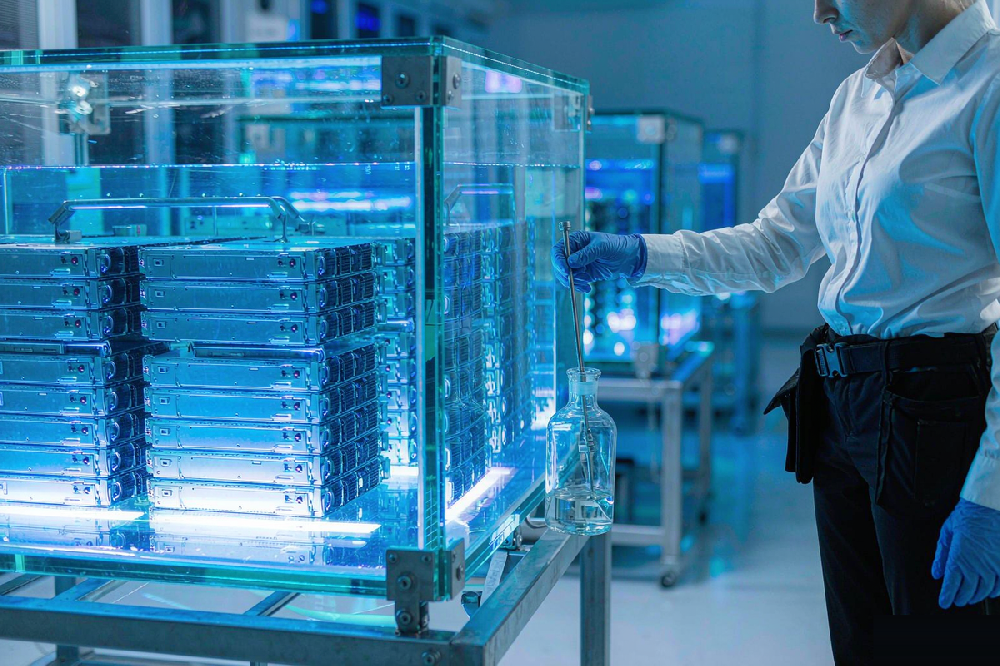
Six things decide how long an immersion fluid lasts. Five of them belong to the operator. The sixth is not a thing at all, and it is the one most buyers worry about. Here is the list first. The explanation follows. Print it. At Glacier Coolant we hand this list to every immersion operator who asks about service life, because the answer is almost never the fluid. The list is not ranked by importance. It runs in the order the problems arrive. Seal comes first because air starts everything else. A breather left open during commissioning does not look like a fault. It will not trip anything. It simply adds oxygen every hour the tank sits there, and it keeps doing that for years. Fill level sits next because a partly filled tank breathes. Each thermal cycle pulls air in across the surface and pushes it back out. That is a slow pump. It never breaks, and it never stops. Temperature is third on the list and first in effect. Heat does not cause ageing by itself. It sets the rate for every other process on this page. A tank running ten degrees above its band is not merely warmer. It is running all of them faster at once. Ingress control is where most operators lose the argument. Hardware goes in wet, or carrying whatever it was stored in. One top-up from the wrong drum undoes a year of discipline, and almost nobody writes it down. The same is true of water. A little water in an immersion tank does not announce itself, but it fouls surfaces and it shifts the readings you are relying on to make decisions. Sample rhythm and additive margin sit at the bottom because they are how you find out. Neither prevents anything. Together they tell you whether lines one to four are actually being honoured, and they tell you late enough that it matters but early enough that it is cheap. There is a reason buyers never see this ordering. Procurement documents list properties, and properties are things a supplier prints. Exposure is not a property. It is a set of habits, and habits do not appear on a data sheet. Ask which of these is the fluid's fault, and the honest answer is none of them. An oxidation-stable immersion formulation is designed not to degrade on its own. It has no built-in expiry. Sitting in a sealed tank at a sane temperature, it does very little for a very long time. What ages it is what reaches it. That is why the usual buying instinct misses. The instinct is to find the longer-lived product and then stop worrying about it. But the same grade that lasts for years in a sealed, correctly filled, temperature-respecting tank will age on schedule in a leaky, hot, half-open one. The enclosure is the bigger lever, and the enclosure has already been bought. So the first move in extending immersion life is not a different purchase. It is closing the paths above. Which is inconvenient, because closing a breather is free and nobody gets credit for it, while changing the fluid specification feels like doing something. Worth naming, because this is where maintenance hours go to die. The chemistry itself. A stable formulation does not spontaneously break down inside a sealed enclosure. It is built not to. A modest, steady load. Normal duty within the design band is what the fluid was made for. It is not a tax on service life, and running a tank gently does not wear the fluid out faster. The absence of a pump. No pump, no fan on the boards, no filter clogging the way a cold-plate loop clogs. Immersion has fewer moving failure modes than anything else in the hall. That advantage is structural rather than chemical, and it is the reason an immersion tank can outlast the loop standing next to it. None of this means the fluid is immortal. It means the list at the top of the page is where the life actually comes from. Immersion buyers usually assume the measurement that matters is a dielectric or breakdown-voltage test. It is not, and we do not publish those numbers. Five signals, none of them exotic, none of them requiring the dielectric measurement that belongs to the equipment maker's material specification. What they require is a commissioning sample and the discipline to compare against it. That is the same discipline every other loop in the hall should already have. How long does immersion cooling fluid last? For years, when oxygen, heat, contamination and additive depletion are managed. The chemistry itself, if oxidation-stable, is rarely the limiting factor. What are the signs an immersion fluid is degrading? Discolouration, a rising acid number, climbing viscosity, and sludge or haze in fluid that used to be clear. All of these are watchable without a dielectric test. How do I monitor immersion coolant without special tests? By trending appearance, acid number, viscosity, water and solids against a commissioning baseline. Those signals predict trouble long before the fluid turns brown. Does the fluid itself wear out over time? Not in a sealed, correctly filled tank. An oxidation-stable formulation is designed not to degrade on its own, so life is set by exposure rather than by age. Is high temperature the main killer? It accelerates every ageing process at once, so it matters. But oxygen ingress and contamination often do more damage, because they are easier to let slip. What about dielectric strength and breakdown voltage? We do not publish those for immersion fluids, and we make no insulation claims. That property is set by the equipment maker's material specification, and the question belongs to them. How often should an immersion tank be sampled? Sample at commissioning to set the baseline, then on a rhythm matched to duty and exposure. Always sample again after a top-up or any breach of the seal. Can I mix a new fill with what is already in the tank? Only if the grades are confirmed compatible. Mixing fluids of different bases or additive packages is one of the most common contamination paths, so verify before topping up. The old answer was a calendar. The better answer is a line you drew yourself. Changing out early is not a precaution. It is a bill. Changing out late is not thrift either, because by then the hardware has been running hotter for months, and the boards have been living in fluid that stopped doing its job quietly rather than loudly. The trigger avoids both. It costs one sample at the start and a line on a planner's screen after that. There is a second benefit that nobody budgets for. When the change-out is a trigger rather than a date, it can be scheduled into a window that suits the compute schedule instead of interrupting one. The calendar version never has that luxury, because the calendar does not know when your hall is quiet. Three things come back. A baseline, written for your fluid and your enclosure rather than copied from a data sheet, so the first reading has a reference. A trend, because drift is what carries the information and the absolute number mostly does not. Every later sample gets compared against the first one, and the drift is what gets reported. A trigger, phrased so a maintenance planner can actually schedule it: act when signal X crosses line Y. Not "replace every N years", which is a guess wearing the costume of a plan. You also get the questions to route to your equipment maker. The dielectric property immersion buyers ask about is theirs to specify, not ours to claim. We hand over the thermal and chemical data and the exact wording of the question, so nothing falls into the gap between the fluid and the hardware. What to do when a liquid-cooled rack runs warm walks the diagnosis order for the loops that do have moving parts. Where the coolant actually works in a hall places this tank among the three loops in a modern data centre. The product range lists the families by temperature band. Seal the tank. Hold the level. Respect the temperature band. Keep water and stray fluids out. Sample on a rhythm. Compare every sample against the one you took at the start. That is the entire immersion maintenance plan. It fits on one page because the fluid was never the hard part. Glacier Coolant builds immersion fluids for the calmest loop in the building. Send us a sample from the tank and we will send back the baseline, the trend, and the trigger your planner can put straight on the calendar.The checklist
# Item What it means in practice How often 1 Seal integrity Breather closed, lid gasket seated, every opening logged Each access 2 Fill level Topped to the design level, no ullage breathing air Monthly 3 Bulk temperature Held inside the band the grade was picked for Continuous 4 Ingress control Boards drained and wiped, no water, no mixed fills Each swap 5 Sample rhythm Drawn on schedule, and always after a breach By duty 6 Additive margin Compared against your own commissioning baseline By trend Why the order runs the way it does
The part that surprises people
What does not shorten life
Monitoring without a dielectric test
Signal Healthy looks like Act when Appearance Clear, stable colour It darkens or hazes Acid number Low and steady The trend line rises Viscosity Inside the spec band It climbs with no temperature change Water and solids Trace or none Anything measurable appears Sludge None Any appears at all FAQ
Turning change-out into a trigger
Calendar replacement Trigger replacement When you act A date someone picked When a signal crosses your baseline Cost of being early Fluid, labour, disposal Nothing Cost of being late A degraded tank and a hot rack Not applicable What it requires A reminder in a system One commissioning sample What arrives when you send a sample
The whole plan on one page