
LM-450-PL Primary-Side Coolant: What the Facility Loop in a Cold-Plate Data Centre Actually Asks For
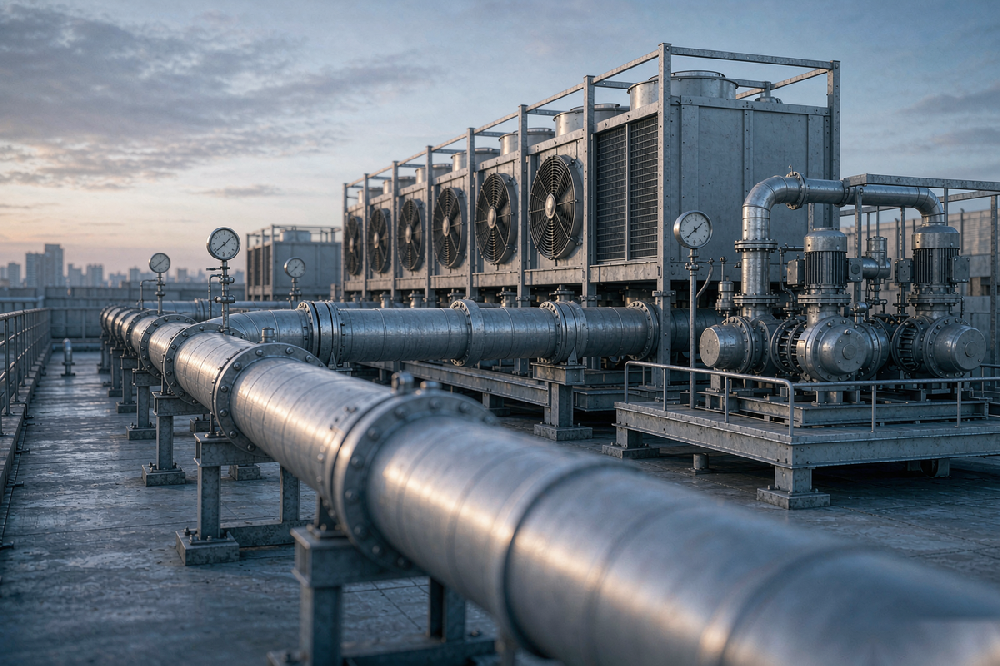
The primary-side loop in a cold-plate hall freezes and corrodes first but gets specified last. What a facility-loop fluid must prove, and why one campus needs a grade of its own.
Facility loop fluid: inhibited propylene glycol. Freeze point −20 °C.
That sentence appears in cooling schedules more often than any other line about the primary side. It gets four seconds in a design review. Then it governs a circuit for a decade.
We read a great many of those lines at Glacier Coolant. Most are not wrong. They are thin. A freeze point and a base fluid name quietly commit you to three things: a concentration, a metal list, and a top-up habit. None of the three appears on the page.
This piece takes the line apart clause by clause. Not to fault whoever wrote it — schedules are short, and this is the standard wording. But the gaps in it are predictable, and they close in a predictable order. If you are writing or reviewing a cold-plate hall specification, the following is the difference between a line that survives first winter and one that survives the fifth.
Clause one: the temperature you have actually committed to
"Freeze point −20 °C" is not a temperature. It is a concentration, written in the wrong unit.
Glycol does not lower the freeze point by existing. It lowers it in proportion to how much of it is in the water. So the number on the page translates directly into a mixing ratio, and the mixing ratio translates into two penalties that no one writes down.
The first penalty is heat capacity. As concentration rises, the fluid carries less heat per litre. A loop sized on water tables and later filled with glycol moves less energy at the same flow.
The second penalty is viscosity. It climbs as concentration climbs, and it climbs exactly when the loop is coldest. Pump head goes up during the free-cooling season, which is the season the primary side exists to exploit.
| Design winter low | What the concentration costs | What to re-check before sign-off |
|---|---|---|
| Mild, around −10 °C | Modest heat-capacity loss | Standard margins usually hold |
| Cold, around −25 °C | Noticeable viscosity rise | Pump head, and exchanger approach |
| Severe, around −40 °C | Largest capacity penalty | Whole heat-transfer budget, not just the pump |
Two mistakes follow from writing the clause badly. The first is specifying the record low instead of the design winter. Record lows are rare events; designing to them buys concentration you pay for every day and use once. The second is specifying a round number because a catalogue used one.
Write the clause the other way round. Name the design winter temperature for the site. State the concentration required to protect against it. Then list the two margins that must be re-verified at that concentration. Now the line carries its own cost.
Clause two: the metal list nobody writes
The second hidden commitment is metallurgy. A facility loop is rarely one metal. Carbon steel pipe runs out to the roof. Stainless fittings join it. Copper sits inside the exchangers. Aluminium appears in some coils and air-side units.
Put two of those in one circuit with any dissolved oxygen present and one becomes the anode. The galvanic couple does the damage, and the couple is created by the loop, not by the fluid.
An inhibitor package built for one metal will protect that metal beautifully and leave the others bare. That is the common failure behind a facility loop that looked clean at commissioning and started weeping at welds in year four. The weld is where two sections meet. It is also where a mixed-metal circuit concentrates its disagreement.
| Wetted metal | How it fails in a facility loop | What the inhibitor has to cover |
|---|---|---|
| Carbon steel | General thinning, then pinholes at low points | Film-forming protection over large area |
| Stainless steel | Localised pitting where chlorides sit | Chloride control alongside the film |
| Copper and brass | Coupled attack on the less noble metal | A package that treats them together |
| Aluminium | Attack at high pH and at hot spots | A buffered window the metal tolerates |
So the clause to add is a wetted-materials list. Not a sentence saying "suitable for all common metals". An actual list, with the aluminium question answered explicitly, because aluminium is the one that varies most between halls and the one most often assumed away.
Clause three: the top-up habit
Fluids do not usually fail by ageing. They fail by dilution.
A facility loop is the largest circuit in the building and the one most exposed. It has a make-up water line. It has gasket weeps that get tightened and then forgotten. It has a roof section that gets drained for a repair and refilled from whatever hose was nearest.
Every one of those events adds water the fluid was not designed around. Hardness and chloride arrive together. Biology arrives with them. The freeze margin moves a little each time, and it moves in the dangerous direction.
The clause that prevents this is short: name the make-up water quality, and name the top-up fluid. Not "top up as required". A named fluid at a named concentration, or a return to the original grade. Then add one line about sampling after any top-up or repair, because that is the moment the drift becomes visible.
That is also the cheapest clause in the schedule. It costs one sentence and it prevents the majority of the freeze incidents we are called about.
| What arrives with a careless top-up | Where it first shows up | The clause that stops it |
|---|---|---|
| Hardness | Exchanger surfaces, as scale | Name the make-up water quality |
| Chloride | Stainless steel, as pitting | Set a chloride limit |
| Biology | Dead legs, under a slime mat | Name a control regime |
| Plain water | Freeze point, drifting upward | Name the top-up fluid |
Where LM-450-PL lands on that line
LM-450-PL is a primary-side formulation. It is a glycol-based, inhibited freeze-protection fluid, built for the circuit that runs between the plant room and the outdoor cold source.
Its three design commitments map onto the three clauses above. Freeze margin comes from a concentration set against the local design winter rather than a catalogue default. Multi-metal protection comes from an inhibitor system engineered to hold a film across carbon steel, stainless steel, copper, brass and aluminium at the same time. Impurity discipline comes from keeping chloride, sulphate, hardness and iron tightly limited, so a drift in those numbers reads as an early signal of ingress rather than a late symptom of a leak.
It also holds a pH buffer in the neutral-to-mildly-alkaline window and stays compatible with the EPDM, FEP and PTFE seals already in the loop. A fluid that swells or cracks a seal converts a non-event into a flood. Seal compatibility is part of the specification, not a footnote to it.
What LM-450-PL is not is a cold-plate grade. The cold-plate loop worries about sub-millimetre channels and about what sits a millimetre from a live board. The facility loop worries about a hard freeze on the roof. Those are different jobs. A campus that fills both from one part number either over-specifies one loop or under-protects the other, and the quiet failure is the second.
What comes back with the quote
A grade per loop, with the reason written down. Matched to each circuit's temperature band, wetted materials and outdoor exposure. The reasoning travels with the part number, so the next engineer inherits the argument rather than re-guessing it.
A concentration line, not a guess. Derived from the local design winter, with the heat-capacity and pump-head consequences stated beside it.
A sampling plan. A baseline at commissioning. A rhythm matched to load and exposure. A trend report comparing every later sample against your own loop's starting point, because a number without a baseline is only a number.
Boundaries, stated. Where a question belongs to the cold-plate maker or the CDU maker, we say so. Where it belongs to us, you get a straight answer and the documents behind it.
FAQ
What coolant does the primary side of a data centre use?
A freeze-protected, inhibited glycol-based fluid built for outdoor service — the circuit that carries heat from the plant room to dry coolers and back.
Does the facility loop need a different grade than the cold plate loop?
Usually yes. The cold plate loop prioritises cleanliness in sub-millimetre channels. The facility loop prioritises freeze margin across outdoor sections. One grade rarely serves both well.
How do I stop the outdoor loop freezing in winter?
Set the glycol concentration from the local design winter temperature, then re-check pump head and exchanger margins at that concentration rather than assuming a water-sized system.
Is glycol freeze protection free?
No. Higher concentration lowers heat capacity and raises viscosity, so the loop's margins should be designed at the working concentration, not at full water flow.
Which metals does a primary-side fluid need to protect?
Typically carbon steel, stainless steel, copper, brass and aluminium in one loop. The inhibitor must protect them together, because dissimilar metals in one circuit create galvanic couples.
Does the facility loop need different seals than the cold plate loop?
The seal materials are usually similar — EPDM, FEP, PTFE — but the larger volume and longer service life of the facility loop make seal compatibility just as important, not less.
Should I sample the primary side as often as the cold plate loop?
Follow published equipment guidance: about every six months on high-density AI loads, about annually on general service. Test after every top-up or repair too. Baseline at commissioning so later samples have something to compare against.
Can one supplier cover both the technology and facility loops?
That is the point of duty-matched grades. A supplier who reads the wetted lists and temperature bands of each loop can match grades to jobs and keep the sampling records for a whole campus in one place.