
How to Keep Coolant Conductivity in Spec: A Field Checklist
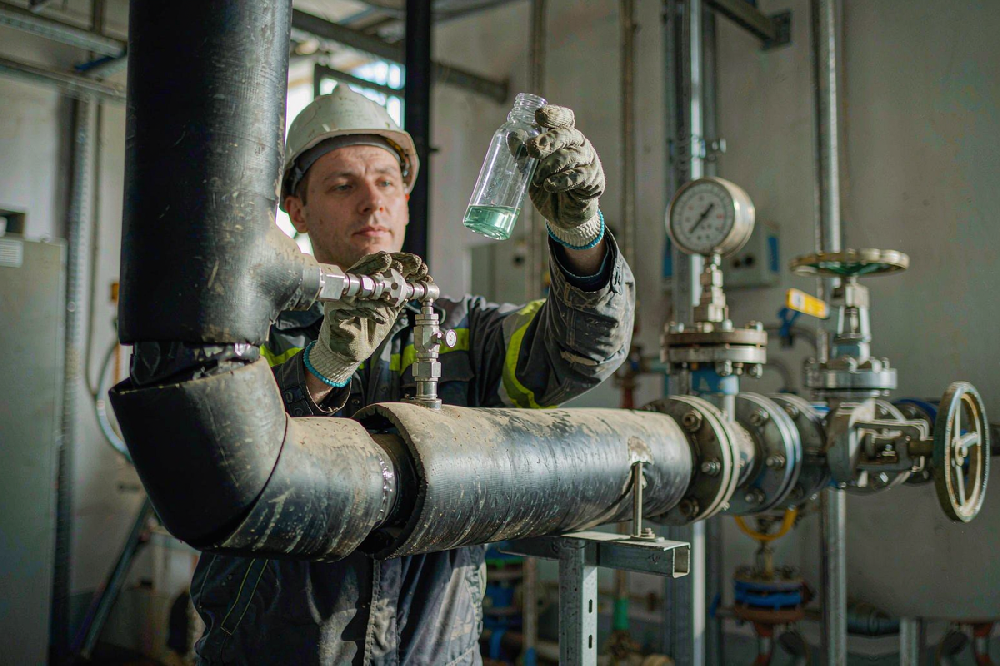
The purchase order said "coolant". What arrived is a water chemistry you now own.
The fluid that left the drum was formulated to a conductivity target. The loop started changing it the day it was filled, and it has been changing it every day since. Keeping the number in spec is not a one-time act. It is a routine, and routines need a schedule or they do not happen.
Glacier Coolant writes this schedule out for every loop we supply, because the fluid only gets specified once while the loop gets managed every day. What follows is that schedule, and the reason behind each line of it.
The routine on one page
| When | What gets done | What gets written down |
|---|---|---|
| Once, at commissioning | Full sample, four signals plus ion profile | The baseline every later reading compares against |
| Every shift | Glance at conductivity and any alarm state | Anything that is not where it was yesterday |
| Every week | Confirm the top-up log against the level trend | What went in, and how much |
| Every month | Conductivity, pH, turbidity | Four numbers on one line |
| Every quarter | Full sample with biology and ion breakdown | The trend, reviewed against the baseline |
| After any event below | A sample, whatever the calendar says | The event, dated |
That is the whole schedule. Everything under it is why.
Once, at commissioning
This is the step that makes the rest of the schedule worth anything, and it is the one most often skipped because the plant is busy starting up.
Draw a full sample before the loop goes into service. Record conductivity, pH, turbidity, biology and the ion breakdown. Write down what healthy looks like for this loop, not for a typical one, because every loop has its own metals, its own make-up water and its own normal.
Without that first sample, every later reading is a guess. With it, a drift becomes something visible, and visible things get acted on. A drift you can see is a maintenance item. A drift you are guessing about is a meeting.
At Glacier Coolant we analyse that first sample and hand back the baseline in writing, because the baseline is the part of this job nobody can do for you later.
Every shift
Thirty seconds, and no instruments beyond what is already on the panel.
Look at the conductivity readout and the alarm state. You are not recording a number. You are answering one question: is this where it was yesterday?
Conductivity that jumps inside a single shift is not drift. Drift does not work that fast. A step change inside a day means an event — a top-up, a repair, a valve left open, a hose connected to the wrong drum. Catch it in the shift and it is a five-minute conversation. Catch it at the quarterly sample and it is three months of unexplained chemistry.
Every week
Reconcile the top-up log against the level trend.
This is the least glamorous line in the schedule and the one that prevents the most incidents. The level tells you the loop lost volume. The log tells you what was put back. If those two do not agree, something is leaving the loop somewhere it should not, and you would rather find that now.
While you are there, confirm that whatever went in was the specified fluid or processed water. Untreated water in a top-up imports chloride, hardness and biology in one move, and it does more damage than a year of well-managed operation.
Every month
Four numbers on one line: conductivity, pH, turbidity, and the elapsed hours since the last top-up.
| Signal | What it catches | Healthy looks like |
|---|---|---|
| Conductivity | Overall ion load and leak risk | Held inside the service red line |
| pH | Acidic drift, local pitting risk | Inside the buffer window |
| Turbidity | Suspended solids, fouling starting | Low and steady |
| Biology | Slime mats, hidden corrosion | Under the control limit |
Read the four together rather than one at a time. A conductivity reading on its own tells you something changed. Conductivity plus pH plus turbidity usually tells you what. Rising conductivity with falling pH is a different problem from rising conductivity with climbing turbidity, and the monthly line is what lets you tell them apart.
Write the four on a single row of a spreadsheet, one row per month, and the job is done in a minute. The row is the point. Four numbers scattered across four reports in three systems tell you very little, because nobody ever sees them side by side. One row a month, in one place, turns into a trend after a quarter and into evidence after a year.
Keep the elapsed hours since the last top-up on that row as well. It costs nothing to add, and it is the column that explains most of the surprises.
Every quarter
The full sample: the four signals, plus biology and the ion breakdown.
This is the review point. Compare against the commissioning baseline and look at the shape of the line rather than any single figure. Flat is the result you want. A flat line at a moderate number is a better outcome than a very low number that has been climbing, because stability is the property that actually protects the hardware.
Some sites tighten this cadence on the highest-density racks, following published equipment guidance for their duty class. Match the cadence to the load rather than to the calendar.
After any of these events
Ignore the calendar. Sample anyway.
| Event | Why it overrides the schedule |
|---|---|
| Any top-up | The most common contamination event in any loop |
| Any repair or breach | Air, water and debris all entered together |
| A conductivity step change | Something happened; find out before it compounds |
| A change of make-up water source | The impurity profile just changed |
| An alarm, even a cleared one | Cleared alarms still leave a cause behind |
The top-up is worth its own rule and its own test. It takes ninety seconds to do and it is the single most common origin of the conductivity problems we get called about.
Taking a sample that means something
The test is only as good as the bottle, and a share of the conductivity scares we hear about turn out to be sampling artefacts rather than loop problems.
Draw from a flowing point, not a dead leg. Flush the tap before you fill it. Use the container supplied for the purpose, not a rinsed bottle from the break room. Label it with the loop, the date and the hours since the last top-up, then send it the same week.
A sample pulled from a stagnant branch reads high and sends you chasing a drift that was never in the loop. Two minutes of care at the tap saves a week of the wrong investigation.
FAQ
How do I keep coolant conductivity in spec?
Monitor the four signals on a rhythm, top up only with the specified fluid or processed water, and act on a drift trigger set against a commissioning baseline.
What should I top up coolant with?
Never untreated tap water. Use the fluid or processed water specified for the loop, and test after every top-up, because the fill is the most common contamination event.
When should coolant be replaced?
When conductivity approaches the service red line, pH drifts out of its window, or turbidity or biology exceed the limit. Planned from the trigger, not discovered at a leak.
How often should I sample?
Once at commissioning to set the baseline, then on a rhythm matched to duty, always after a top-up or a repair. Tighten it on the highest-density racks.
Why does the baseline sample matter so much?
Without it, every later reading is a guess. The baseline is what turns a drift into something visible and actionable rather than something discussed.
Does biology really affect conductivity?
Yes. Microbial activity acidifies the solution and its slime fouls micro-channels. Both push conductivity up, and both hide corrosion underneath.
Is conductivity the only safety number?
No. It is the one most tied to leak risk, but pH, turbidity and biology explain a conductivity drift and often move before it does.
Who owns conductivity, the operator or the supplier?
The operator owns the loop, the top-ups and the schedule. We own the fluid specification and the sample analysis. Almost all drift starts on the loop side of that line.
Who owns which line
| Line in the schedule | Owner |
|---|---|
| Commissioning baseline | Joint — you draw it, we analyse it |
| Shift glance | Operations |
| Weekly top-up reconciliation | Operations |
| Monthly four-signal line | Maintenance |
| Quarterly review | Maintenance, with the trend report |
| Event-triggered samples | Whoever was there |
Most conductivity drift starts on the loop side of that split, which is why the routine matters more than the drum. The fluid is specified once. The loop is managed every day.
If a line in that table has no name against it on your site, that is the line to fix first. Every unresolved conductivity problem we are called about turns out to have one of these rows blank, and it is almost never the quarterly review.
What to do when a liquid-cooled rack runs warm walks the diagnosis order when something has already gone wrong. Where the coolant actually works in a hall describes the three loops. The invisible red line in conductivity explains what the number is guarding. The product range lists the families by band.
Run the schedule and the number looks after itself
There is no trick in any of this. A baseline, a rhythm, a rule about what goes in the top-up, and a trigger that turns a drift into a date on the calendar.
Sites that do this do not think much about conductivity, because it never surprises them. Sites that do not do this think about it constantly, usually in the week after something failed, and usually with the wrong drum blamed for it.
Glacier Coolant builds heat-transfer fluids for the circulating loops between the machine and the point of use. Send us a sample and we will send back the baseline, a monitoring cadence matched to your duty, and the drift trigger for your dashboard. You run the schedule. We read what it produces, and we tell you when a line starts to bend.
Chaoyang Guangda Chemical Co., Ltd. — ISO 9001 certified, 30,000 t/year capacity. No. 97, Section 5, Wenhua Road, Longcheng District, Chaoyang City, Liaoning Province, China. Tel +86 421 7228 333 · binghelm@gd-chem.com