
Fuel-Cell Coolant Ion Purity: What Keeps the Stack Alive
In a fuel-cell stack the coolant is a neighbour to the membrane, not a bystander. Ion purity, measured as conductivity, is what stops contaminants reaching the MEA. Here is how to spec and hold it.
A fuel-cell stack does not fail loud. It loses voltage cell by cell while the cooling loop, sitting one plate away from the membrane, carries the very ions that do the damage. The coolant in a hydrogen stack is a neighbour to the proton-exchange membrane, not a bystander — and that is why ion purity, not freeze point, is the first number a stack maker should ask about.
Glacier Coolant supplies low-conductivity cooling fluids for fuel-cell systems, built on the LM-4D grade family. This article is the spec note we hand before a loop is filled: what ion purity protects, what breaks it, and the one claim we will not make.
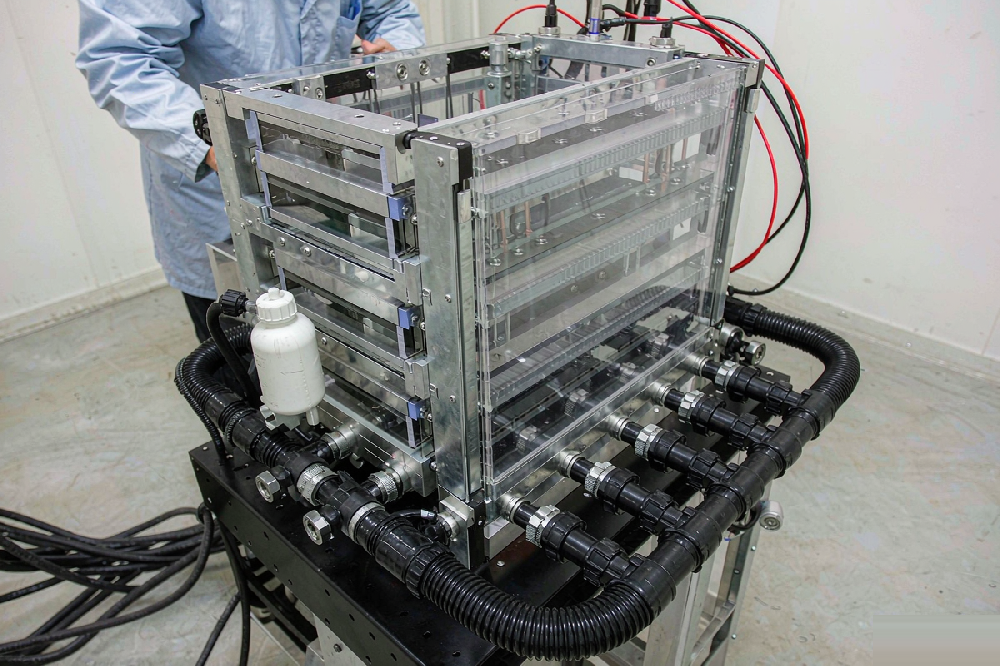
Ion purity is the job, not a footnote
In a PEM stack the membrane moves protons from one side to the other. The coolant sits against the cell plates, separated from that chemistry by little more than a gasket. Any ionic impurity the fluid carries can migrate toward the membrane through a weak point. Once contaminants reach the MEA, they poison the catalyst layer. The damage is chemical, not mechanical, which is why a clean-looking fluid can still be the cause. The stack then loses performance it does not get back. The coolant's first job is therefore to stay electrically quiet. It should carry as little current as possible, so it never feeds the membrane the ions it should not have. A fluid that does this is a neighbour the cell can ignore.
This is why a fuel-cell spec reads differently from a chiller spec. A chiller cares about freeze point and pumpability. A stack cares about those too, but it cares first about what the fluid might donate to the cell. Get that wrong and the rest of the loop design is academic.
What ion purity means in numbers
A conductivity meter answers the question directly: how readily does this fluid carry current? Lower microsiemens per centimetre means fewer free ions in solution. That means a smaller chance of a stray path into the cell. The meter turns a worry into a number you can watch. The reading is simple, repeatable, and taken on a draw from your own loop — no special rig required.
Our low-conductivity grades hold at or below five microsiemens per centimetre. That is a nameplate value we publish, because it is the one you can verify in your own tank. We would rather you check it than trust us. That figure, not a brochure dielectric number, is the control a stack depends on.
| Conductivity | What it means for the stack |
|---|---|
| Above 20 μS/cm | Ions free to migrate; membrane at risk |
| 5 to 20 μS/cm | Marginal; watch and sample often |
| At or below 5 μS/cm | Quiet loop; our low-conductivity target |
What the five-microsiemens line actually protects
The line is not arbitrary. It is the point where the loop stops being a contributor to membrane ageing and becomes a neutral neighbour. Below the line, the fluid still moves heat and still holds its inhibitor film. It simply does not add ions to the system. Heat transfer and purity are not a trade — the grade does both. A stack that runs inside that band for years is a stack whose coolant is doing the one job that matters most.
The cost of crossing the line is slow and invisible. Voltage falls a little each week. The warranty clock runs. By the time anyone opens the stack, the membrane has already taken what it will not give back. The loss is booked long before it is seen. Holding the band is cheaper than explaining the drop.
What contaminates a fuel-cell loop
Purity is a state, not a shipment. The fluid leaves clean and the loop tries to dirty it. Knowing the sources is how you keep the band instead of hoping for it.
| Source | How it enters | What it does |
|---|---|---|
| Make-up water | Top-ups with untreated water | Adds dissolved salts and ions |
| Metal ions | Mild corrosion at a fitting | Drives conductivity upward |
| Inhibitor drop-out | Thermal stress on the package | Releases bound species into loop |
| External ingress | A bad seal during service | Introduces unknowns you cannot name |
The first source is the one teams underestimate. A loop loses volume, someone tops it with tap water, and the conductivity climbs before the next reading. Treated make-up water removes the largest, most avoidable source in one step. The rule that says no other kind enters the tank is the cheap half of the fix. Most loops that drift were topped with the wrong bottle.
Why we do not call it an insulator
A buyer will sometimes ask for a dielectric or insulation number. We do not publish one, and not because the grade is weak. Low-conductivity coolant is not an insulator. It is a low-ion fluid. The honest claim is the conductivity you can measure, not a breakdown voltage you cannot repeat in the tank. We say what the meter shows, not what a rig implied. Our note on ion conductivity versus dielectric claims makes the same point for storage duty. Ask for the trackable number, and treat any supplier who leads with a figure you cannot re-check as a risk.
A 2026 commissioning, without the name
To keep it real without naming a client: a fuel-cell stack maker in northern China filled a cooling loop in 2026. The grade was low-conductivity, qualified against the stack's own plate and seal materials. The qualification step is what most buyers skip, and it is the step that decides whether the band holds. The spec did not open with freeze point. It opened with conductivity, because the stack's first warranty risk was membrane ageing, not winter. The loop went in with a sampling plan from day one. The five-microsiemens band is a reading they take, not a promise they hope for. That discipline is why the stack is still in warranty and still on voltage.
That order of priorities is the part worth copying. The freeze point was easy. The conductivity was the work, and the conductivity is what the membrane cares about.
Sampling cadence for a fuel-cell loop
A hydrogen stack earns its keep on uptime, so the coolant is sampled, not assumed. The sampling schedule we use for industrial loops applies here with one extra rule. Conductivity is read every time, because it is the early warning the membrane depends on. Skip the conductivity line and you are flying the stack blind. A drift upward is the first sign of a dirty source. Catching it early is the difference between a filter change and a stack strip-down. The second is a quarter of downtime; the first is a Friday afternoon.
| Event | What to read |
|---|---|
| Start-up fill | Conductivity, pH, inhibitor load |
| Monthly | Conductivity only, quick draw |
| After any top-up | Conductivity before and after |
| Six-month full | Conductivity, metals, inhibitor load |
The monthly reading is the cheapest insurance in the whole plant. Five minutes with a meter, one entry in a log, and you know whether the membrane's neighbour is still behaving.
How to specify a fuel-cell coolant
The short list for a procurement spec is three lines. Name the conductivity ceiling. Name the plate and seal materials. Ask the supplier for the number they can prove in your loop. If they cannot show it, the grade is a guess with a label. A grade that meets the band on paper but cannot show its conductivity in service is a risk you do not need. The glycol-versus-engineered view covers why a formulated low-ion grade beats a repurposed glycol when the duty is a membrane next door. Next to a cell, the fluid's job is restraint, and restraint is what a purpose-built grade is made for.
See the low-conductivity grades for the full temperature range and the materials each is qualified against.
FAQ
What conductivity should fuel cell coolant have?
Hold at or below five microsiemens per centimetre. That is the band where the loop stops feeding ions to the membrane.
Why does ion purity matter for the MEA?
The coolant sits against the cell plates. Ionic impurities can migrate to the proton-exchange membrane and poison the catalyst, a loss the stack does not recover.
What contaminates a fuel cell cooling loop?
Make-up water, mild corrosion at fittings, inhibitor drop-out under heat, and service ingress through a bad seal. All of them raise conductivity.
Do you claim the coolant is an insulator?
No. Low-conductivity coolant is not an insulator. We publish conductivity, the number you can measure in your loop, not a breakdown voltage.
How often should I sample conductivity?
Every month as a quick draw, and always before and after a top-up. Conductivity is the early warning the membrane depends on.
Can one grade cool both the stack and the balance of plant?
Sometimes, if the band and materials match. Send the stack model and temperature range; we name the grade and the reason.
What if conductivity drifts up?
Find the source — usually a top-up with untreated water or a small corrosion site — and correct it before the next sample. Early action avoids a stack strip-down.
How do I specify this in procurement?
Name the conductivity ceiling, the plate and seal materials, and ask for the number the supplier can prove in service. A formulated low-ion grade beats repurposed glycol next to a membrane.
Final thoughts
A fuel-cell stack lives or dies on what the coolant does not do. Ion purity, held at or below five microsiemens per centimetre, is what keeps contaminants off the membrane and the voltage where it should be. Spec the trackable number, sample it on a rhythm, and treat conductivity as the alarm it is.
Send us your stack model, operating temperature band, and plate materials. Glacier Coolant will return a low-conductivity grade and the conductivity ceiling you can track, not an insulator claim you cannot.