
Galvanic Corrosion in Cooling Loops: Why the Fluid Takes the Blame
Why a leak is rarely the fluid's fault. The 50 mV rule, anode-to-cathode area ratio, where oxygen gets in, and the three fixes in the order that works.
The fluid takes the blame because it is the thing you bought. In the loops we get called to, the fluid is usually the electrolyte — the medium that lets the current flow, not the reason the current exists.
Two questions, answered up front, because these are the ones people type at midnight.
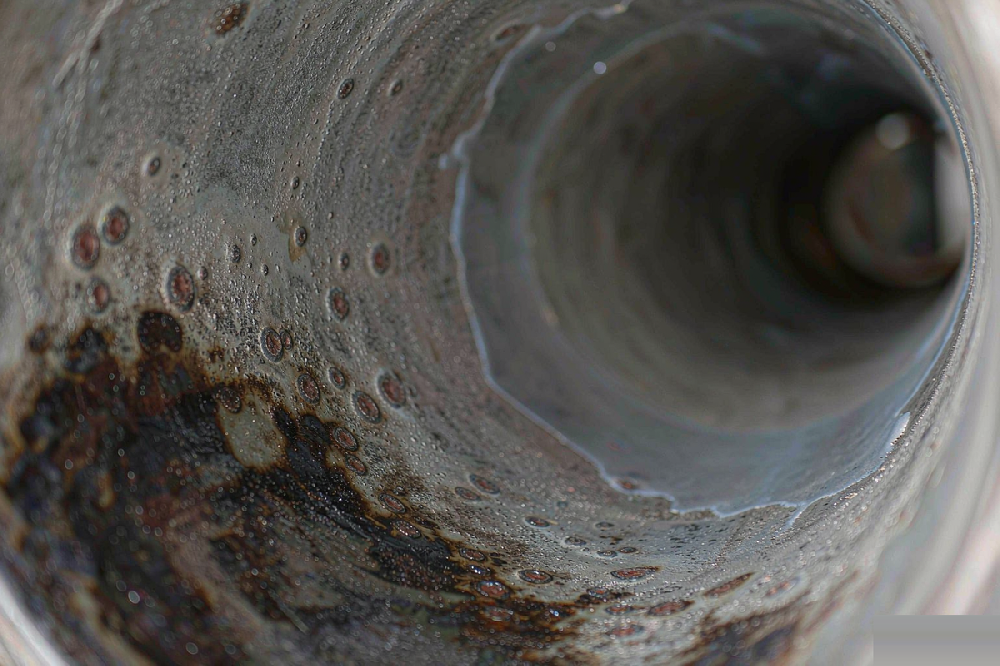
Your fluid turned brown. Brown or black fluid with red-brown sludge at the bottom is corrosion product in suspension, not necessarily degraded fluid. It means metal is coming off somewhere in the loop right now. Whether the fluid itself has also broken down is a separate question, and the only way to separate them is a sample: pH, iron and copper content, water content, and whether the inhibitor package is still carrying.
Your plate exchanger keeps leaking. Repeated leaks at the same unit, especially at the gasket edge or under a bolt, are almost never a fluid defect. They are local corrosion — crevice or pitting — fed by oxygen entry, a mismatch of metals, or a chemistry drift nobody caught. Replacing the plates without fixing any of those three buys you another year.
Glacier Coolant supplies the fluid, so we have an interest in saying this clearly: most of the loops we get called to were not failed by the fluid. They were failed by decisions made before anyone chose the fluid.
What corrosion looks like before it becomes a leak
Three signs, in rough order of how often we meet them:
| Sign | What it usually means | Urgency |
|---|---|---|
| Fluid darkens, goes turbid, red-brown sludge at the bottom | Iron oxide in suspension; active corrosion upstream | Sample within days |
| Pressure falls, you top up more often than you used to | You are losing fluid — find the loss before you replace it | Stop and locate |
| Visible pits, cracks or pinholes at a plate, weld or tube wall | Local corrosion already advanced | Plan the outage |
The middle one gets missed. A loop that needs topping up every few weeks is telling you where the leak is going to be, weeks before it becomes one.
Two cathode reactions, and only two
Every aqueous corrosion case in this industry comes down to one of two reactions at the cathode.
Oxygen absorption. O₂ + 2H₂O + 4e⁻ → 4OH⁻. It runs under a neutral or weakly acidic water film, and the product is the red-brown rust you recognise. This is the one you have.
Hydrogen evolution. 2H⁺ + 2e⁻ → H₂↑. It needs strongly acidic conditions. In fluids formulated above pH 7 it is rarely the mechanism.
Why bother with the chemistry: if your corrosion is running on oxygen absorption, then oxygen is a reactant, and cutting the oxygen supply slows the reaction. That single fact explains failures that look mysterious on site.
A loop at an aerospace test facility lost two heat exchangers in one year. The cause was not the grade. The return line discharged as a spray into the tank and dragged air down with it, every minute of every run. A coastal site under the same owner did it properly — sealed tank, submerged return — and ran for years.
Uniform thinning versus the kind that stops your line
| Type | Behaviour | How predictable |
|---|---|---|
| Uniform, general | Even wall thinning across the wetted surface | Good. A wall-thickness allowance handles it |
| Pitting | Deep narrow attacks, often under a deposit | Poor. Initiation is invisible |
| Crevice | Oxygen concentration cell inside a gap | Poor, but predictable by location |
| Intergranular, stress corrosion cracking | Along grain boundaries, or cracking under tensile stress | Poor, and the most dangerous |
Uniform thinning is the one you can design around, because you can measure it. Everything else starts where you are not looking.
Pitting is usually initiated by halides breaking the passive film. One copper-tube loop at a chemical plant in Shandong developed three separate leaks; fluoride had come in with make-up water and nobody was testing it.
Crevice corrosion you hunt by geometry rather than by chemistry. It forms where solution stagnates and oxygen cannot reach: flange faces, under bolt heads, at gasket edges, inside a weld that was never fully penetrated. If your leaks keep appearing at joints, geometry is your answer.
Where your metals sit in the galvanic series
Two metals sharing one electrolyte make a battery. Put them far apart in the series and the less noble one corrodes faster than it would alone. The order below is the one published in standard corrosion handbooks for room-temperature aerated water. Treat it as a ranking, not as voltages to design against — actual potentials move with temperature, flow, film condition and what is dissolved in the fluid.
| Activity | Metals, most active first | Practical note |
|---|---|---|
| Most active | Magnesium, zinc | Rarely structural in a cooling loop; appears as sacrificial anodes |
| High | Aluminium and its alloys, carbon steel, cast iron | The usual anode in any mixed-metal loop |
| Middle | Lead, tin, brass, copper | Often the cathode; brass and copper drive attack on steel and aluminium |
| Noble | Stainless steel in the passive state, titanium | Stable on their own, and dangerous as large cathodes against a small aluminium or steel anode |
A rule of thumb used widely in materials engineering: once the potential difference between two wetted metals exceeds roughly 50 mV, treat them as a couple and design around it. Titanium steel paired with copper sits far beyond that, and the pairing is more common than it should be.
Two rules follow, and the second one is the one people get wrong.
Minimise the number of different metals in one loop. Every extra alloy is another couple.
Watch the area ratio. A small anode against a large cathode is the failure mode. The corrosion current concentrates on the small surface and drills through it. Aluminium row pipe with copper fittings is exactly this shape: large copper cathode, small aluminium anode, and the aluminium loses.
A cold store in Fujian ran aluminium evaporator rows with copper connections and started finding pinholes at two to three years. Nothing was wrong with the fluid. The metal pairing was wrong.
The other half of the story: whether the fluid can hold a film
A large potential gap is only half the equation. The current has somewhere to go only if the electrolyte lets it through. Two things decide that, and neither appears on a product sheet.
How much the fluid resists current. Low conductivity means ion transport is slow, so the couple drives weakly even when the metals are far apart. This is why low-conductivity grades exist at all: they are specified where stray currents and mixed metallurgy cannot be avoided.
Whether a film can hold. Inhibitors work by building and repairing a thin surface layer. Where the layer stays intact, the metal is separated from the electrolyte and the current has nowhere to run. Where flow scours it off, or the geometry lets solution stagnate, the layer never establishes and the bare metal does all the work.
This is why a tight specification does not guarantee a quiet loop. Keeping the metals close in the series helps. So does keeping oxygen out. Neither survives a stagnant corner, a depleted inhibitor, or a make-up regime nobody owns.
Where the oxygen and the water come from
Fixing corrosion means closing the entry paths. In the order we find them on site:
An unsealed tank. Air dissolves in at the surface continuously. A water seal or a nitrogen blanket at around 1500 Pa stops it.
A return line discharging above the liquid level. Spray entrains air far faster than surface contact does. Put the return below the level.
No vent at the pump discharge. Trapped air causes cavitation, and cavitation damage looks like corrosion and behaves like it. One data centre lost a pump casing this way.
Water left after a pressure test or a repair. Blow the line down with dry nitrogen rather than water, especially on grades formulated to be water-free.
Make-up water carrying chloride or fluoride. Test make-up water before it becomes part of your loop chemistry.
There is one more factor worth knowing, and one we would not design around. On a handful of sites, corrosion has run noticeably faster on sections close to large transformers. Stray fields are suspected in the literature. On a live loop it is very hard to separate that from temperature, flow and oxygen on the same run of pipe, so treat it as a hypothesis rather than an input to a specification.
Three levels of response, in the order we use them
| Response | What it costs | When it is the right first move |
|---|---|---|
| Change the metallurgy — move to a more corrosion-resistant alloy | Capex, plus more heat transfer area: stainless conducts less well than copper, so you buy area to keep duty | Design stage, or a rebuild you were going to do anyway |
| Fix the chemistry — dedicated inhibitor and pH stabiliser, dosed to the fluid you have, then held there | Low, and recurring | New leaks in an otherwise sound loop |
| Clean and refill — flush properly and charge high-purity fluid | Downtime plus fluid cost | The fluid itself is carrying corrosion product and spent inhibitor |
Level 1 is not a free win. Stainless resists a great deal, but it pits in chloride-bearing low-oxygen crevices, and it costs more per unit of heat moved than copper. Titanium behaves well electrochemically and is limited by price and by how much of your existing structure accepts it.
Level 2 is where most loops should start, and it fails for one reason: an inhibitor added once and never checked is not a programme. Packages deplete. Whatever you dose, the loop needs a sampling rhythm that tells you before the iron count does.
Long term, two things keep it fixed: a high-efficiency dry filter to control water, and a sampling rhythm. A closed loop mostly needs its make-up tank level watched. An open loop wants pH monthly and a full panel twice a year.
What this way of thinking cannot tell you
Being straight about the limits is more use than pretending every loop has an answer.
A fluid sample cannot locate a pit. Chemistry reads the bulk. It tells you the loop is corroding and roughly how fast on average. Finding the elbow needs thickness survey, borescope or dye penetrant, none of which we do.
A trend beats a single number. One analysis tells you almost nothing. The third one, three months later, tells you whether anything you did worked.
Handbook orders are not your loop. Temperature, concentration, film condition and dissolved gases all move real potentials. Use the series to rank risk, then sample.
Coatings and plating are not our scope. We do not specify or apply them, and will not advise as though we did.
We do not do the metalwork. No welding, no tube pulling, no exchanger replacement.
Some duties have no grade. Strongly oxidising environments and certain extreme low-temperature combinations sit outside what we make. We will say so rather than sell you something close.
FAQ
Why did my heat transfer fluid turn brown?
Almost always suspended iron oxide, meaning something in the loop is corroding. It can also be thermal degradation or cross-contamination with another fluid or refrigeration oil. A sample separates the three: pH, metals in solution, water content, and whether the inhibitor is still carrying.
Can I run copper and aluminium in the same cooling loop?
You can, but you are accepting a galvanic couple and the aluminium will be the anode. If you must, keep the aluminium area large relative to the copper, keep the fluid inhibited, and sample it. Where the design allows it, pick one metal and stay with it.
Does a lower corrosion rate on a datasheet mean the fluid is better?
Not on its own. Ask what metal, what temperature, what test method and whether the figure is a screening value or a field result. A number without those four pieces of information cannot be compared with another number.
How often should I test my heat transfer fluid?
A closed loop mainly needs its make-up tank level watched and a periodic panel. An open loop wants pH checked monthly and a full analysis twice a year. After a leak, tighten the interval until you know the trend.
Can I just dose inhibitor into a leaking loop?
You can, and it will slow things down, but a leak is a symptom of damage that already happened. Dosing without finding the oxygen path or the metal pairing is a delay, not a repair.
Is stainless steel the fix for everything?
No. It resists a lot, costs more, transfers heat worse than copper, and has its own failure mode — crevice and pitting in chloride-bearing, low-oxygen crevices. It solves some loops and moves the problem in others.
What should I tell a supplier before buying fluid for a mixed-metal loop?
The metals in the wetted circuit, including fittings and braze, the duty temperature range, and whether the loop is sealed. Without those three, any grade recommendation is a guess with a datasheet stapled to it.
My fluid is clear and the numbers are fine. Can the loop still be corroding?
Yes, right up to the day it leaks. Clear fluid with good numbers and no history means you know the bulk; it tells you nothing about a pit forming under a deposit in a dead leg.
Final thoughts
Corrosion is a property of the loop, not of the drum the fluid came out of. The fluid matters — conductivity, film behaviour and inhibitor life all sit on the fluid side — but the metals you paired, the oxygen you let in and the sampling you skipped usually decide the outcome first.
Where we fit: Glacier Coolant builds more than 30 grades across roughly -135 °C to 350 °C, and we would rather match the grade to your metallurgy than sell you the one that topped someone's chart. If you are standing next to a leaking exchanger, send the grade, the metals in the loop and the duty temperature. We will tell you which of the three responses we would start with, and which ones your loop would waste money on. The grades listed by temperature band are on our product collection page if you want to see the shape of the range first.