
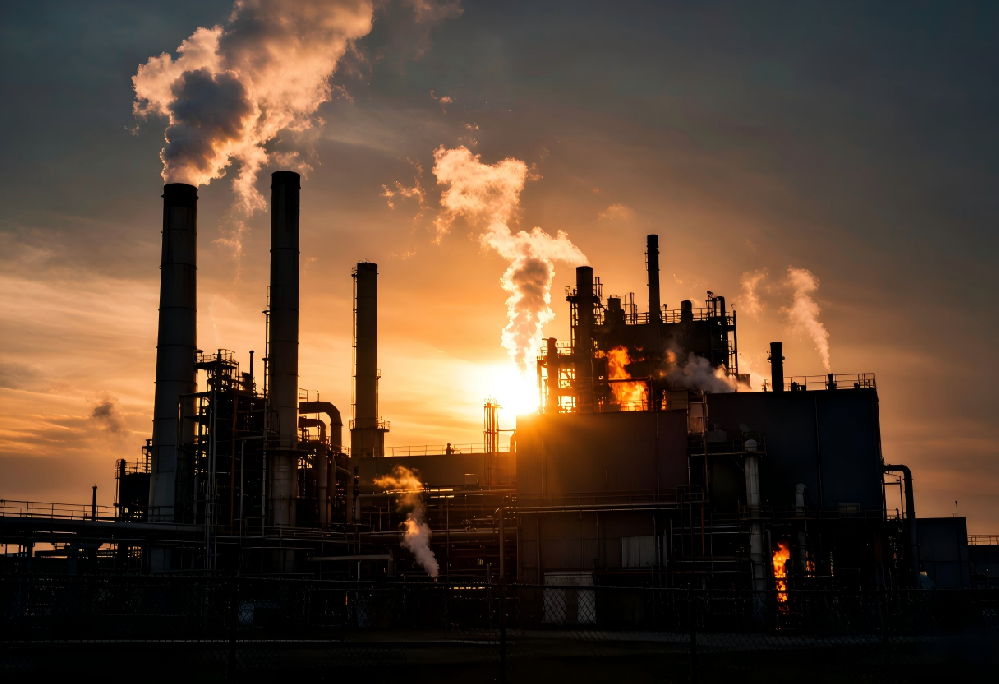

Every day, factories around the world burn through enough energy to power a small country, then watch as half of it escapes through exhaust stacks, cooling towers, and pipe insulation as waste heat. Phase change materials are beginning to capture that lost energy, and the implications for industrial efficiency are enormous.
The Department of Energy estimates that American manufacturing alone discards between 5 and 13 quadrillion BTUs of waste heat annually, equivalent to the energy content of roughly 1.5 billion barrels of oil. Globally, the figure is staggering. The International Energy Agency calculates that industrial waste heat represents approximately 20 percent of all energy consumed by the manufacturing sector worldwide. This is not a marginal inefficiency. It is one of the largest untapped energy resources on the planet, and it is being vented into the atmosphere.
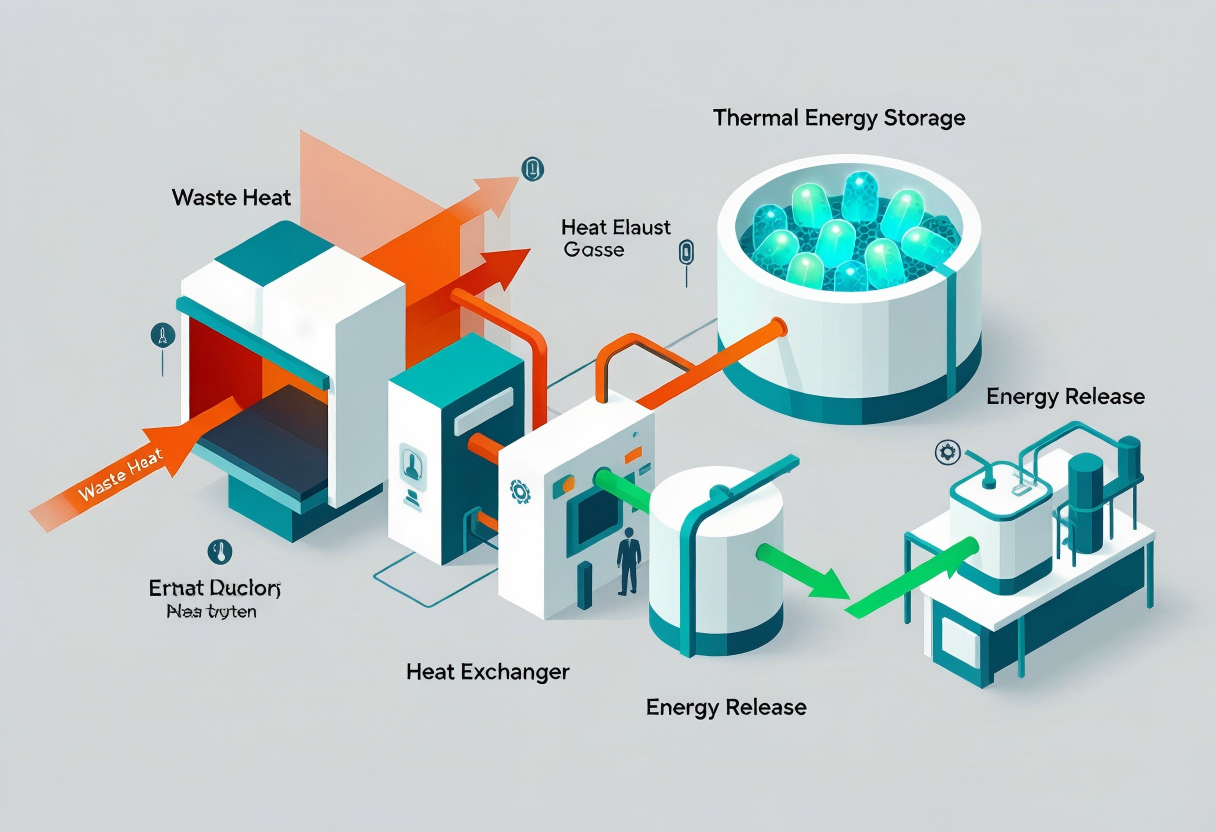
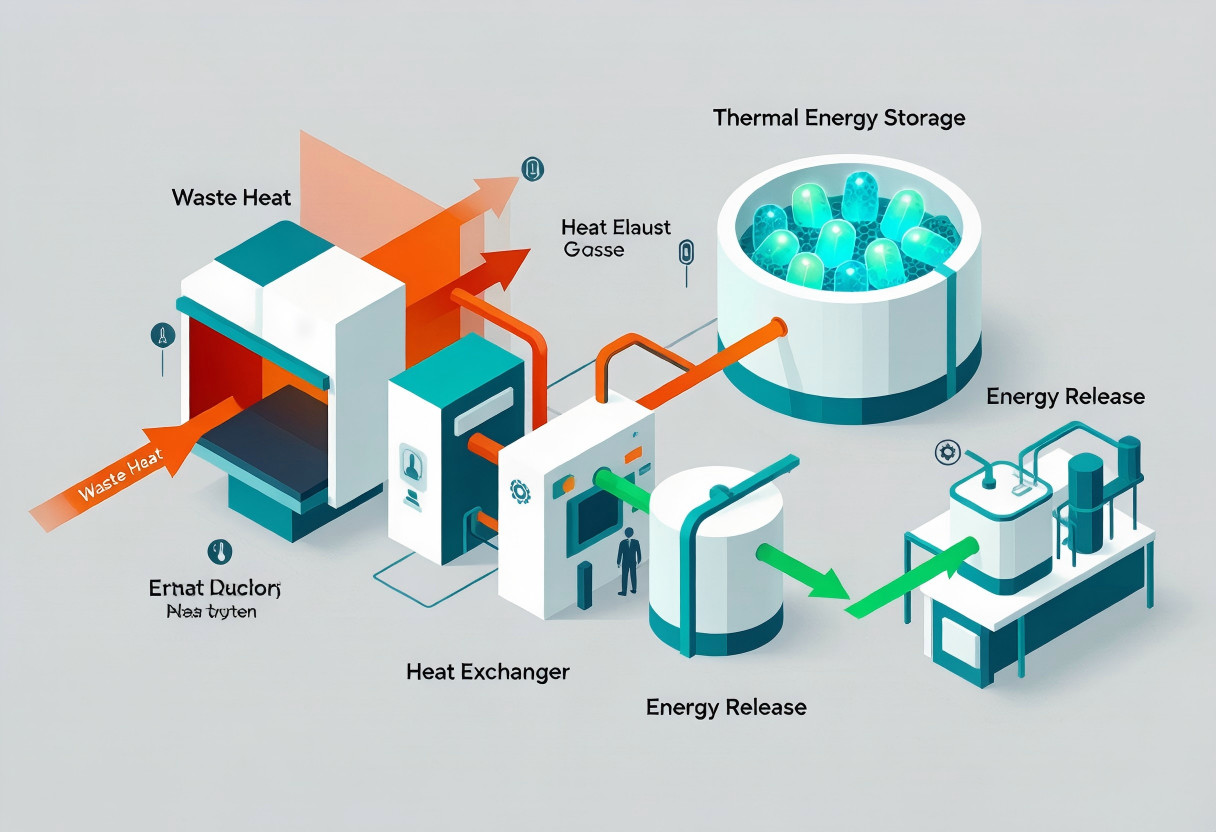
Capturing waste heat is not a new idea. Heat exchangers, recuperators, and economizers have recovered flue gas heat and process steam energy for decades. But these conventional technologies have inherent limitations. They require a simultaneous demand for the recovered heat: you can only use recovered thermal energy if something nearby needs it right now. If the timing does not align, the heat is wasted. Phase change materials solve this temporal mismatch by storing waste heat when it is available and releasing it when it is needed, effectively creating a thermal battery from industrial losses.
The Scale of the Problem: Where Industrial Heat Goes
Industrial waste heat exists across a spectrum of temperatures, and the temperature determines both the recovery difficulty and the potential applications. Low-grade waste heat, below 100 degrees Celsius, is the most abundant but the hardest to utilize because it has limited thermodynamic potential. Medium-grade heat, 100 to 400 degrees, offers more options for recovery and reuse. High-grade heat, above 400 degrees, is the most valuable but typically comes from exhaust gases that are corrosive, particulate-laden, and challenging to handle.
< 100°C
Low-grade: cooling water, condensate, air exhaust
100-200°C
Medium-low: process drain, drying exhaust
200-400°C
Medium-high: steam exhaust, furnace waste
> 400°C
High-grade: flue gas, kiln exhaust
The distribution of waste heat across industries reveals where PCM-based recovery can have the greatest impact. Steel manufacturing, cement production, glass making, chemical processing, and food and beverage production each generate waste heat at different temperatures, volumes, and temporal patterns. The table below summarizes the primary waste heat sources by industry and the PCM opportunities they present.
| Industry | Primary Waste Heat Source | Typical Temp Range | PCM Opportunity |
|---|---|---|---|
| Steel / Iron | Furnace exhaust, cooling water | 200-900°C | Preheating combustion air, space heating |
| Cement | Kiln exhaust, clinker cooling | 200-500°C | Raw material preheating, power generation |
| Chemical | Reactor cooling, distillation condensers | 80-250°C | Process heating, boiler feedwater |
| Food & Beverage | Oven exhaust, pasteurization, CIP systems | 60-180°C | Hot water generation, space heating |
| Glass | Furnace regenerators, annealing lehrs | 250-600°C | Cullet preheating, steam generation |
| Pulp & Paper | Dryer exhaust, black liquor recovery | 120-300°C | Process water heating, district heating |
Why PCM Changes the Waste Heat Equation
Traditional waste heat recovery suffers from a fundamental problem: the mismatch between when heat is generated and when it can be used. A steel mill's electric arc furnace runs in batches, generating enormous heat for 45 minutes followed by a 30-minute gap. A food processing plant's pasteurization line produces hot wastewater during production hours but needs heat for cleaning and sanitation during off-hours. A cement kiln runs continuously, but the heat demand for raw material drying varies with ambient humidity and production rate.
Conventional heat exchangers operate in real-time. Heat flows from the source to the sink through a heat exchanger, and if there is no immediate demand on the sink side, the recovery opportunity is lost. Thermal oil systems and steam accumulators can store some heat, but they are bulky, operate at high pressures, and have relatively low energy density per unit volume.
Phase change materials change this equation through their latent heat storage mechanism. A PCM with a melting point of 120 degrees Celsius can absorb heat from a 150-degree exhaust stream, storing 150-250 kilojoules per kilogram in the process, and hold that energy at a near-constant 120 degrees until it is needed. When a downstream process requires heat, the PCM solidifies, releasing the stored energy at a predictable, stable temperature. This temporal decoupling is the key innovation.
Energy Density Comparison
Water, the most common sensible heat storage medium, stores approximately 4.2 kJ per kilogram per degree of temperature rise. To store 1,000 kJ of energy, you need roughly 24 kilograms of water raised by 10 degrees. A paraffin PCM with a latent heat of 200 kJ/kg stores the same 1,000 kJ in just 5 kilograms of material, with virtually no temperature change during charging or discharging. This 5:1 density advantage means PCM storage systems can be dramatically smaller than sensible heat alternatives for the same energy capacity.
Representative Applications: How PCM Heat Recovery Works in Practice
Application 1: Steel Mill Vent Gas Heat Recovery
Consider a mini-mill processing scrap steel through an electric arc furnace (EAF). The EAF operates at approximately 1,600 degrees Celsius, with exhaust gases exiting at around 600 degrees. A conventional recuperator captures the highest-grade heat for preheating scrap, but the medium-grade exhaust, at 250-300 degrees after the recuperator, is typically vented. This is a common operating profile across electric arc furnace facilities globally.
A PCM array with a melting point of 180 degrees, positioned in the exhaust ducting downstream of the recuperator, can capture this medium-grade heat. Using a salt-based composite with a latent heat of 210 kJ/kg, the PCM absorbs heat during the furnace's 45-minute power-on cycle and releases it during the 30-minute tapping and charging gap. The recovered heat can preheat combustion air for auxiliary burners and provide space heating during winter months.
Thermal modeling of this configuration projects recovery of approximately 14,000-15,000 GJ of thermal energy annually, representing 7-9 percent of the furnace's total energy input. Such a system could reduce natural gas consumption for auxiliary heating by 35-40 percent and cut annual CO2 emissions by 800-900 tons. Payback is typically achieved in 20-24 months, driven primarily by natural gas cost savings.
Application 2: Food Processing Plant Water Heating
In the food and beverage industry, pasteurization and cleaning processes generate large volumes of warm wastewater at 55-70 degrees, while plants simultaneously consume significant energy heating fresh water to 80-85 degrees for cleaning-in-place (CIP) systems. This simultaneous waste and demand profile is common across dairy, brewing, and processed food facilities worldwide.
A PCM thermal storage tank with a melting point of 58 degrees, charged by the warm wastewater stream and discharged to preheat incoming fresh water, addresses this mismatch. Using a hydrated salt formulation with a latent heat of 185 kJ/kg, such a system can store 2,000-2,500 kWh of thermal energy in a 10,000-12,000-liter tank, roughly one-third the volume that a conventional warm water storage tank would require for the same energy capacity.
Facilities implementing this approach have reported 25-35 percent reductions in water heating energy consumption and peak electrical demand reductions of 150-200 kW, generating approximately $100,000-150,000 in annual energy savings. Additional benefits include reduced wastewater temperature, which lowers effluent discharge fees, and improved CIP temperature consistency, which improves cleaning effectiveness and food safety compliance.
The beauty of PCM waste heat recovery is that it does not require you to change your process. You are capturing energy that is already being generated and thrown away. Every kilowatt-hour you recover is one you do not have to buy, burn, or emit. In industries where margins are measured in fractions of a cent per unit, that is transformative.Glacier Coolant Industrial Solutions Team
Application 3: Cement Kiln Heat for District Heating
Cement plants operating rotary kilns at approximately 1,450 degrees traditionally recover high-grade exhaust heat for raw material preheating but vent the remaining medium-grade heat through cooling towers. In regions where cement plants are located near residential areas with district heating networks, this vented heat represents a significant untapped resource.
A large-scale PCM storage system, using a composite PCM with a melting point of 75 degrees, can capture this medium-grade exhaust heat during continuous kiln operation. During evening hours, when residential heating demand peaks, the PCM discharges through a heat exchanger connected to the district heating network. This temporal shift is essential: the kiln runs 24 hours a day, but residential heat demand is concentrated in the evening and overnight hours.
Modeling indicates that such a system, at a scale of approximately 450 cubic meters of PCM, could provide heating for 1,500-2,000 households, reducing natural gas consumption by 8-10 million cubic meters annually and cutting CO2 emissions by 15,000-18,000 tons per year. The cement plant generates revenue from heat sales while reducing cooling tower operating costs and water consumption.
The Technical Challenges of Industrial PCM Systems
Deploying PCM in industrial environments presents challenges that laboratory research does not fully capture. Industrial waste heat streams are rarely clean. Exhaust gases contain particulates, corrosive compounds, and moisture that can degrade PCM performance and damage containment systems. Sulfur compounds in flue gas can react with salt hydrate PCMs, altering their phase change characteristics. Particulate accumulation on heat exchanger surfaces reduces heat transfer efficiency over time, requiring regular cleaning or filtration.
Thermal cycling stability is another concern. Industrial processes may cycle thousands of times per year, and PCM degradation over time can reduce storage capacity, shift melting points, or cause phase separation. Salt hydrates are particularly susceptible to phase separation, where the hydrated salt and its water of crystallization physically separate after repeated cycling, destroying the material's thermal storage capability. Additives and thickeners can mitigate this, but material selection and formulation engineering are critical.
Glacier Coolant's industrial PCM solutions are designed to address these challenges through composite formulations that combine high latent heat capacity with long-term cycling stability. The company's PCM products undergo accelerated aging testing to verify performance over thousands of thermal cycles, consistent with the demands of industrial thermal cycling. For corrosive environments, specialized encapsulation and heat exchanger designs can isolate the PCM from direct contact with contaminated exhaust streams while maintaining efficient heat transfer.
Economic Analysis: The ROI of PCM Waste Heat Recovery
The financial case for PCM-based waste heat recovery depends on several factors: the quantity and temperature of available waste heat, the cost of the fuel being displaced, the temporal match between heat supply and demand, and the capital cost of the PCM system. Generally, PCM waste heat recovery systems show payback periods of 18 months to 5 years, with the shortest paybacks in facilities with high fuel costs, continuous heat generation, and significant temporal mismatch between heat supply and demand.
System costs vary widely based on scale and complexity. A small-scale PCM recovery unit for a food processing plant might cost $50,000-$150,000, while a large industrial installation for a steel mill or cement plant can range from $500,000 to $3 million. Government incentives, including tax credits for energy efficiency investments and carbon pricing mechanisms, can significantly improve the financial returns.
The carbon dimension is increasingly important. As carbon pricing mechanisms expand, the avoided emissions from waste heat recovery acquire direct financial value. At a carbon price of $50 per ton, a system that avoids 1,000 tons of CO2 annually generates $50,000 in carbon credit value, improving project economics substantially. At higher carbon prices, $100-150 per ton, which many analysts project for the late 2020s, the economics become compelling for a much broader range of industrial facilities.
The Path Forward: Policy, Technology, and Scale
Several trends are converging to accelerate PCM adoption in industrial waste heat recovery. First, energy prices are rising in most major manufacturing economies, driven by geopolitical factors, carbon pricing, and the transition away from cheap fossil fuels. This widens the gap between the cost of purchased energy and the value of recovered waste heat, improving project economics.
Second, decarbonization mandates are forcing industrial facilities to reduce their carbon footprints. The EU's Carbon Border Adjustment Mechanism, effective 2026, imposes carbon costs on imported goods, creating a competitive advantage for manufacturers who can demonstrate lower-carbon production processes. Waste heat recovery directly reduces carbon intensity, and PCM systems make it possible to capture heat that was previously unrecoverable.
Third, PCM technology itself is maturing. Materials costs are declining as production scales. Composite formulations address the thermal conductivity and cycling stability limitations that historically constrained industrial deployment. System integration expertise is growing, with engineering firms developing standardized PCM heat recovery packages that reduce design and installation costs.
The potential is vast. If the global manufacturing sector recovered just 10 percent of its waste heat through PCM and other technologies, the energy savings would exceed 15 exajoules annually, roughly equivalent to the total energy consumption of France. The carbon reduction would exceed 1.2 gigatons of CO2 per year. These are not marginal numbers. They represent a meaningful contribution to global climate goals, achieved not through new energy production but through more intelligent use of energy already being consumed.
For industrial operators, the question is shifting from whether to invest in waste heat recovery to how quickly they can deploy it. The technology is proven. The economics are improving. The regulatory direction is clear. The waste heat is there, flowing out of stacks and cooling towers every hour of every day, carrying with it the energy and carbon that industry can no longer afford to lose.
About This Analysis
This report was compiled by the Glacier Coolant industrial applications team, drawing on DOE and IEA data, industry analysis, and proprietary PCM system design experience. Glacier Coolant manufactures phase change material solutions for industrial waste heat recovery, process thermal management, and energy storage applications. For site assessments or technical consultations, contact the industrial solutions division.