The global push toward carbon neutrality is reshaping how industries consume and distribute energy. Traditional cooling systems, while functional, suffer from a fundamental limitation: they can move cold, but they cannot store it. Once the chiller stops, the cooling stops.
Glacier Coolant is bridging this gap with an integrated approach that combines phase change energy storage with efficient heat transfer fluid transport — creating a system that both stores and delivers cold on demand.
The Traditional Role of Heat Transfer Fluids
Heat transfer fluids — also known as secondary coolants — serve as the workhorses of refrigeration systems. Their job is straightforward:
Absorb cold from a chiller or evaporator
Circulate through pipes to the point of use
Release cold to cool a product, space, or process
Return to the chiller to repeat the cycle
Common examples include water, brine, ethylene glycol, and specialized products like Glacier Coolant's LM series.
The limitation: These fluids transport cold in real time. If the refrigeration unit stops — whether due to maintenance, power outage, or peak demand pricing — the cooling supply stops as well. There is no buffer.
The Missing Piece: Energy Storage
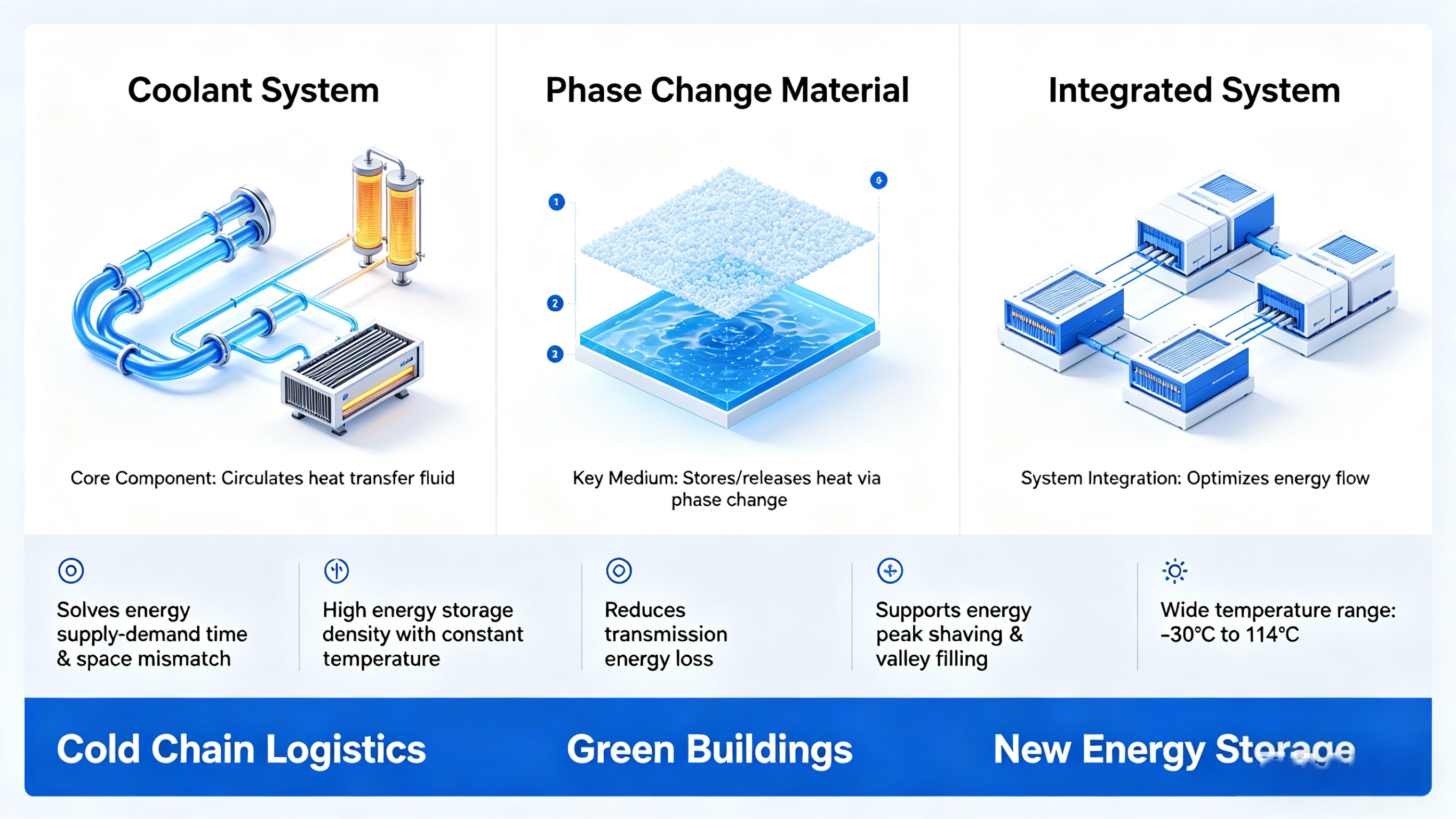
Phase change materials (PCMs) offer a solution. By melting and freezing at nearly constant temperatures, PCMs absorb and release large amounts of latent heat — effectively functioning as thermal energy batteries.
Key advantages of PCMs:
Store large quantities of cold energy in a compact volume
Release energy at a stable, predetermined temperature
Can be charged during off-peak hours (e.g., overnight) when electricity is cheaper
Help decouple energy supply from demand
The challenge: PCMs store energy well, but they do not move it. Releasing stored cold to a distant point of use requires an additional transport mechanism.
The Breakthrough: Storage + Transport in One System
Glacier Coolant has developed an integrated storage-transport cooling system that combines the strengths of both technologies:
| Component | Role |
|---|---|
| PCM storage module | Stores cold energy during off-peak or renewable-rich periods |
| Heat transfer fluid | Transports stored cold from the module to the point of use |
| Heat exchanger (terminal) | Delivers cold precisely where needed |
How it works:
During low-cost electricity hours (e.g., nighttime), the PCM module is charged with cold energy.
When cooling is needed — during peak hours or when the chiller is offline — the heat transfer fluid circulates through the PCM module, absorbing stored cold.
The fluid then travels to the terminal heat exchanger, releasing cold exactly where required.
This closed-loop system effectively decouples cooling generation from cooling delivery — solving the time and space mismatch that plagues conventional refrigeration.
Performance Benefits
The integrated storage-transport system delivers measurable improvements:
Energy cost reduction: Charge PCMs using low-cost off-peak or renewable electricity; discharge during peak rate periods
Temperature stability: PCMs release cold at a nearly constant temperature, minimizing fluctuations that can damage sensitive products
Lower transmission losses: The system maintains stable temperatures during transport, reducing energy waste
Demand response capability: Shift cooling loads away from peak grid hours, supporting grid stability and reducing carbon emissions
Redundancy: Provides backup cooling during chiller maintenance or power interruptions
Applications Across Industries
This approach is particularly valuable in sectors where cooling demand is time-sensitive or where energy costs vary significantly throughout the day:
Cold chain logistics – Maintain temperature during transport without continuous compressor operation
Green buildings – Shift air conditioning loads to off-peak hours
New energy storage – Integrate with renewable sources like solar and wind
Industrial process cooling – Stabilize temperatures during production cycles
Glacier Coolant: A Leader in Integrated Cooling Solutions
With over 30 years of experience in heat transfer fluid development, Glacier Coolant has expanded into phase change materials — creating a comprehensive portfolio that spans both storage and transport.
Current capabilities include:
A full range of heat transfer fluids across all temperature zones
PCM products covering –30°C to 114°C
An integrated storage-transport experimental platform combining PCM modules with LM‑8 and LM‑4 coolants
A demonstration facility for energy-efficient, low-carbon cooling
This integrated approach positions Glacier Coolant as a pioneer in the next generation of thermal energy management — helping industries reduce energy waste, lower costs, and move toward carbon neutrality.
Looking Ahead
In the second part of this series, Glacier Coolant will explore specific case studies and performance data from the storage-transport cooling platform.
For industries ready to move beyond traditional cooling limitations, the message is clear: storing cold is just as important as moving it.