
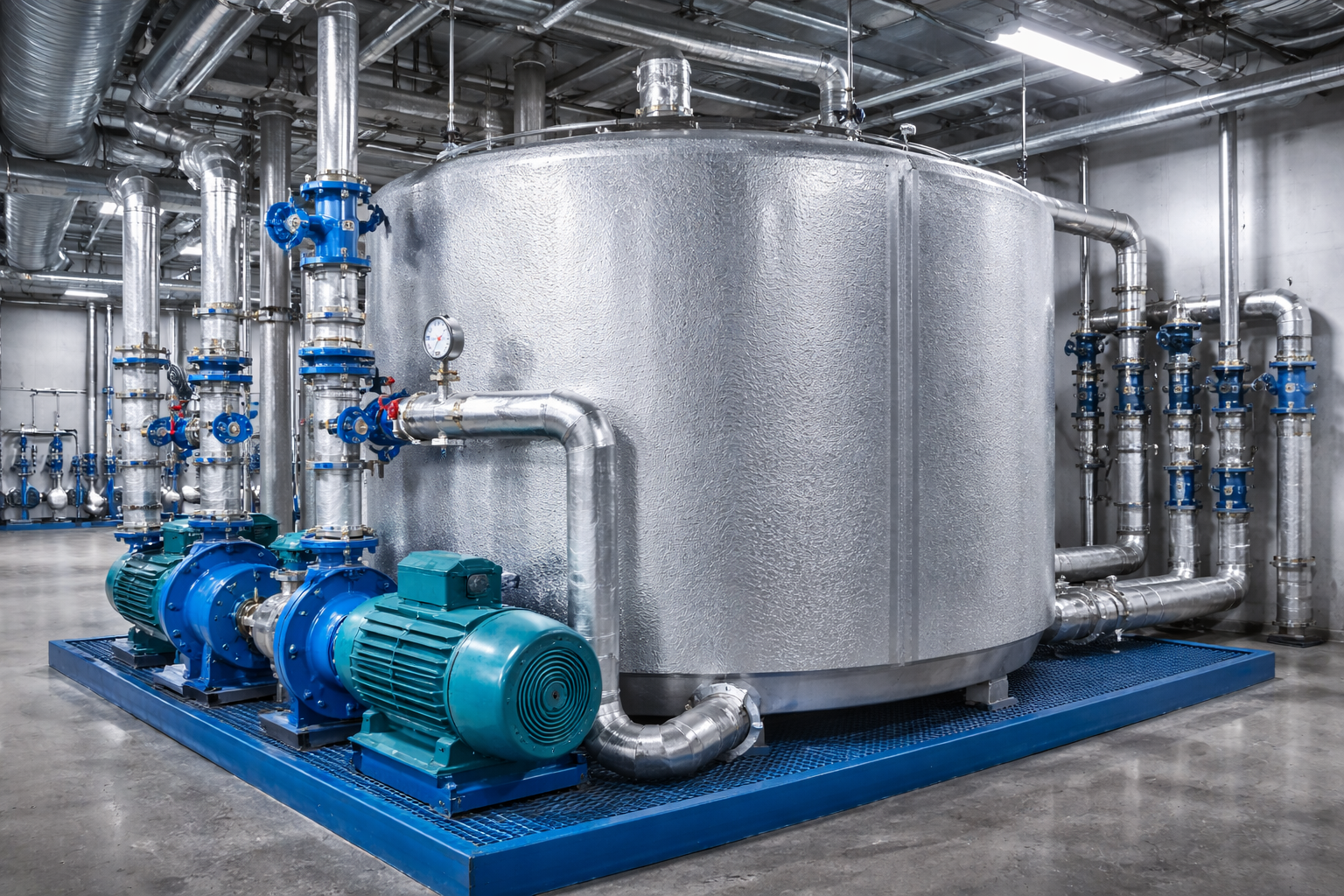
In coolant systems, the method of liquid supply can vary based on system requirements. Among the different configurations, the secondary pump liquid supply system is the most commonly used. A critical component of this system is the intermediate water tank, which plays a vital role in maintaining the system's stability and optimizing energy consumption. Below, we analyze the functions and considerations of the intermediate water tank.
Functions of the Intermediate Water Tank
Circulation Mode:
The primary side of the system circulates between the water tank and the refrigeration unit.
The secondary side circulates between the water tank and the end-use cold equipment.
Typically, the primary side operates on a fixed flow rate system, while the secondary side uses a variable flow rate system.
Primary Side Requirements:
The primary side is mainly concerned with the startup and shutdown of the refrigeration unit. When the unit starts up, it operates for a short period and cannot restart immediately after shutting down. There is usually a minimum interval of 15 minutes required between shutdown and restart. During this period, the intermediate water tank must be able to supply sufficient cooling load to meet system requirements.
Secondary Side Requirements:
The load on the secondary side is not stable and may fluctuate. Therefore, during system operation or in the reaction time after the refrigeration unit shuts down, the intermediate water tank must provide adequate cooling capacity to meet the fluctuating end-load demands. This ensures the system operates smoothly without temperature fluctuations affecting the refrigeration unit or end-use equipment.
Energy Efficiency of the Intermediate Water Tank:
If we assume the water tank is an infinitely large thermal storage system (acting as a constant temperature cold source), the refrigeration unit would deliver cooling energy during off-peak hours, and the end-users could draw the necessary cold from the tank based on their production needs. In this scenario, the system would achieve optimal energy efficiency, and the refrigeration equipment could be selected for higher performance.
However, in reality, the water tank’s capacity must be considered from both an economic and investment perspective. The return on investment should be reasonable, with a static payback period for the tank of no more than 5 years.
Selecting the right intermediate water tank is essential for the overall performance of coolant systems. The tank must be appropriately sized to ensure stable operation of both the refrigeration unit and the end-use equipment. At Glacier Coolant, we specialize in providing refrigerant solutions designed for efficient system applications, ensuring optimal energy use and reliable performance.