
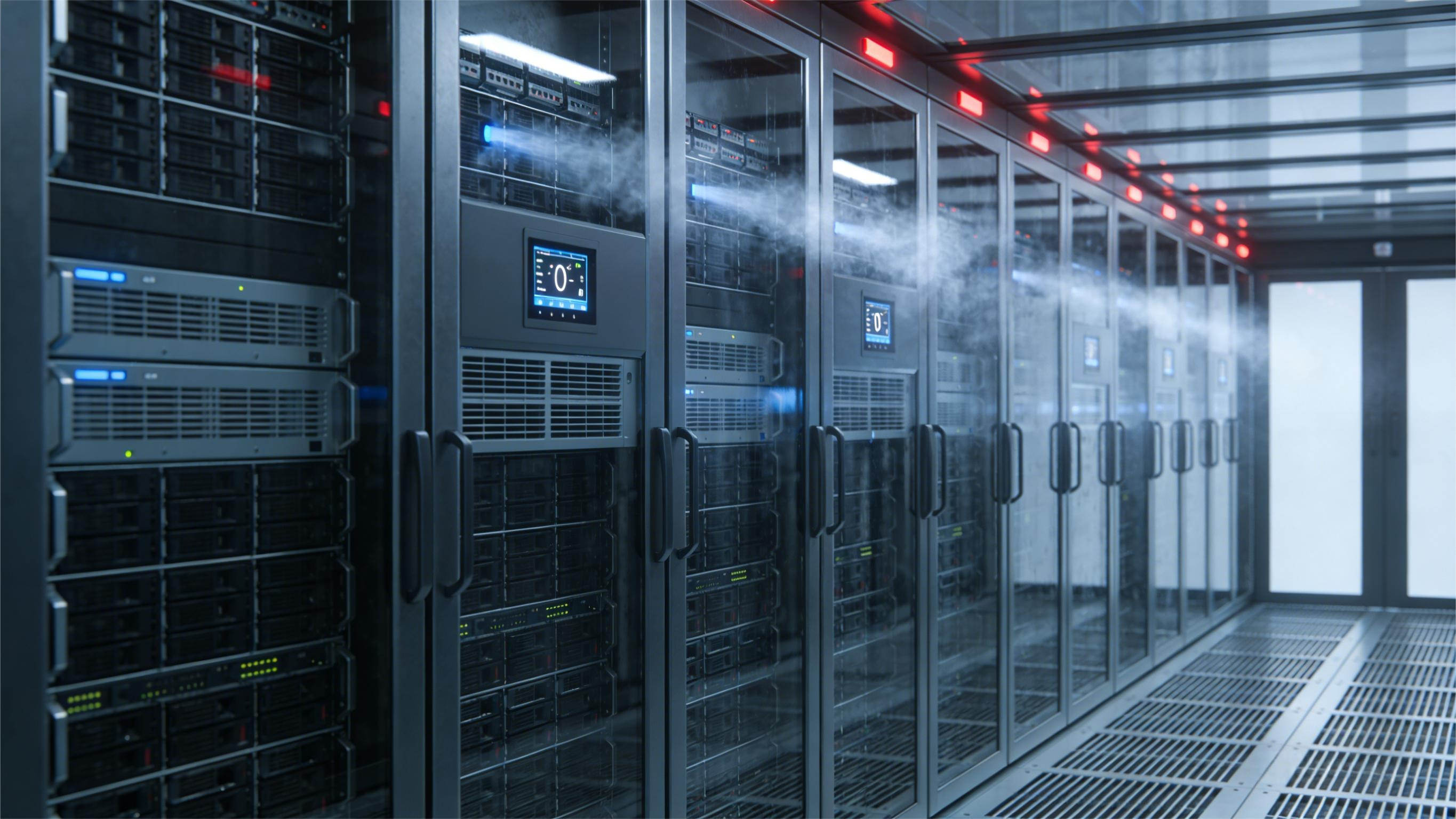
Advanced Cold Plate Liquid Cooling Fluids Reduce Cost and Improve Efficiency in Data Centers
As data centers continue to scale in computing density and power consumption, thermal management has become a critical factor in ensuring system stability, energy efficiency, and long-term reliability. Liquid cooling—especially cold plate cooling—has emerged as one of the most effective solutions for managing high heat flux at the chip level. Glacier Coolant, a specialist in advanced heat transfer fluids, has been deeply involved in cold plate liquid cooling applications for data centers for more than a decade.
Glacier Coolant’s LM-4D and LM-4Y liquid cooling fluids were among the earliest formulations applied when cold plate liquid cooling systems began to appear in data center infrastructure. One of the company’s earliest installations has now been operating continuously for nearly ten years, demonstrating long-term system stability and consistently controlled energy consumption. This operational track record highlights the importance of selecting the right cooling fluid—not only for thermal performance, but also for overall system cost and design optimization.
How Cooling Fluids Influence System Cost
As the liquid cooling industry has developed, an increasing number of cooling fluids have entered the market. Many system designs focus primarily on achieving the required cooling capacity, then compensate for fluid limitations by enlarging heat exchangers, increasing flow rates, or adding more complex components. While effective, this approach often leads to higher equipment costs, increased material usage, and more complicated system architectures.
To understand how cooling fluids directly influence equipment cost, it is essential to look at the fundamental objective of a data center cooling system: transferring waste heat generated by chips to the outdoor environment while maintaining safe and stable operating temperature and humidity conditions. In essence, the cooling system forms a series-connected heat transfer network, where the chip acts as the heat source and the ambient environment serves as the heat sink.
In this heat transfer process, the total heat flow depends on the temperature difference between the chip control temperature (Ts) and the ambient temperature (T0), as well as the total thermal resistance (R) across each interface. Energy dissipation during operation is closely related to these resistances. Similar to electrical circuits—where voltage, current, and resistance determine power loss—thermal systems benefit most from reducing resistance rather than simply increasing input power.
Reducing Thermal Resistance Through Fluid Properties
Every interface in a heat transfer path introduces thermal resistance, making resistance reduction a key focus in cold plate cooling design. The primary methods to reduce thermal resistance include increasing heat transfer area, improving material thermal conductivity, and enhancing the convective heat transfer coefficient of the cooling fluid.
Among these variables, heat transfer area and convective heat transfer coefficient are closely linked. A higher convective heat transfer coefficient allows designers to achieve the same cooling performance with a smaller heat transfer area. This directly reduces machining complexity, material consumption, and overall equipment cost.
This is where the advantages of Glacier Coolant’s LM-4D fluid become particularly significant. The specific heat capacity of LM-4D is approximately twice that of conventional thermal oils, enabling it to carry substantially more heat at the same flow rate. At the same time, its thermal conductivity is more than three times higher than that of typical thermal oils, greatly enhancing convective heat transfer performance.
As a result, cold plate systems using LM-4D can operate with more compact heat exchangers, simpler structural designs, and lower pumping requirements—while still maintaining stable chip temperatures. These benefits translate directly into reduced capital expenditure and improved system-level efficiency.
Supporting the Next Generation of Data Centers
With increasing chip power density and growing pressure to improve energy efficiency, liquid cooling is rapidly becoming a mainstream choice for modern data centers. However, the performance of liquid cooling systems depends not only on hardware design, but also on the fundamental thermophysical properties of the cooling fluid itself.
Glacier Coolant remains focused on the development and application of high-performance liquid cooling fluids for cold plate and other advanced cooling architectures. By combining long-term operational validation with application-oriented fluid design, the company continues to support data center operators and system integrators in building more efficient, reliable, and cost-effective cooling solutions.
About Glacier Coolant
Glacier Coolant is a technology-driven enterprise specializing in heat transfer fluids and liquid cooling solutions. With decades of experience in thermal management and a broad portfolio covering low- and high-temperature applications, the company serves industries including data centers, cold storage, chemicals, and advanced manufacturing.